This post is a follow-up to the article about sodalite. This time I am writing about the sand sample from which I picked these beautiful blue sodalite grains. It was an easy task to pick them because the grains are large and there are lots of them. Most of the sand is made of sodalite. Other major component is dolomite (gray crystals).
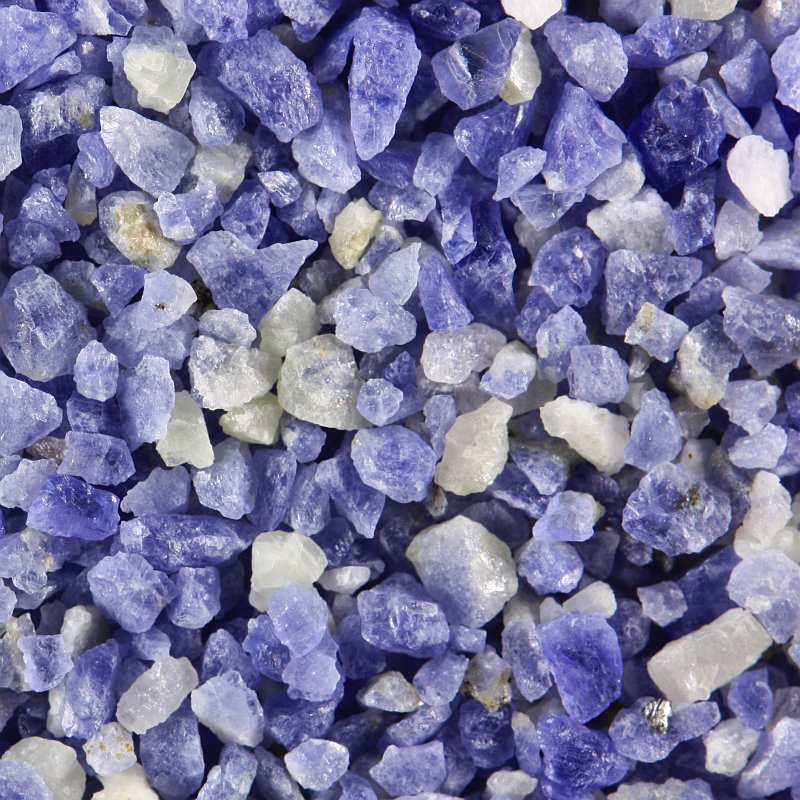
Sand sample from Namibia containing blue sodalite and gray dolomite. The width of the view is 14 mm.
As much as I know this sand sample is one of the most desirable gems sand collectors wish to have in their collections. The other highly sought after sample is probably the one from Japan that contains star-like tests of forams. I wrote a post titled star sand and sun sand where you can see how these forams look like.
The sodalite sand from Namibia is probably not a natural sand. I can’t say it for sure because I have never visited the collecting place but the composition (only dolomite and sodalite which are both rare in sand) and angularity of the grains do not leave much room for alternative explanations. The sample is from a sodalite mine in NW part of Namibia.
The sand itself may not be natural. It is probably what is left of crushed stones but for me this is no problem. I like them all, no matter whether they come from crushed rocks or natural sand.
It is of course interesting to know what type of rocks were the source material of the sand. Sodalite is usually magmatic mineral1. Sometimes sodalite forms in contact metamorphosed carbonate rocks but magma is involved there as well. The most likely interpretation is that silicon-deficient and sodium-rich magma intruded into the dolomite formation and solidified there as an extremely feldspathoid-rich plutonic rock known as foidolite. This rock type contains more than 60 percent feldspathoids in a ternary diagram of alkali feldspar, plagioclase, and feldspathoids. Since I can’t find feldspars, I assume that it is foidolite. I did some googling as well and one of the sources confirmed that there is indeed a mine in Namibia where sodalite-bearing foidolite is mined.
It may come as a surprise but it seems to me that we have to thank the European Union and its regulations for that. In EU it is mandatory for dimension stone dealers to use scientific terminology. No more can they classify all of their rocks into marble and granite. It seems unbelievable but sometimes EU and its huge bureaucracy machine does something that seems to be genuinely useful, at least for me and other geologists. Rock dealers, I am afraid, would probably not agree with me.
References
1. Deer, W. A., Howie, R. A. & Zussman, J. (1996). An Introduction to the Rock-Forming Minerals
You may also like the gallery of colors in sand.
thanks for the second post. I still can’t get over the color, almost intoxicating 🙂
Aloha,
Absolutely beautiful. Do you happen to know where I can get even a tsp of this beautiful sand? I live on the Big Island of Hawaii and collect sand ~ I have never seen anything like it!!
Please let me know…
Mahalo,
Noelani
I am not aware that someone has larger stockpile of this sand. You could ask for it in the sand forum
WOW! That’s a beautiful sample! Would look fantastic next to my red garnet & ruby samples as well as my green Trinitite, black & green Hawaiian, red & amber sandstone samples from Australian & Utah and my gypsum white sand from White Sand Dunes! Would like to go to Frasier Island near Brisbane, Australia and collect each of the many “rainbow” colored sands that are there.
I am wondering if it is possible to purchase some of this blue sodalite sand. My fiance and I are getting married in the summer of 2014 and would like to do a sand ceremony, but me being the geologist that I am, I want our ‘sand’ to be mineral sand. He mentioned that he would like his to be blue and I REALLY love this. So if you have anyway of getting some please let me know! Thank you!
I am not aware that anyone is offering this sand for sale. The best approach most likely is to collect/buy rocks that contain lots of sodalite and then crush the rocks to make sand artificially. After all, these grains on the picture above are also pieces of crushed rocks. You won’t find natural blue beach sand.
Hi Siim
About natural sand, where there is rock there is sand, maybe the first braking of this rock was manmade, and if you would look around the are of that mine in Namibia you would find more rounded samples, and you would not know the diverence.
Rudy
PS: I have one sample also from the blue sodalite