Chert is a hard and compact sedimentary rock, consisting dominantly of very small quartz crystals. It is a common rock type which occurs mostly in carbonate rocks either in nodular form or in layers (bedded chert).
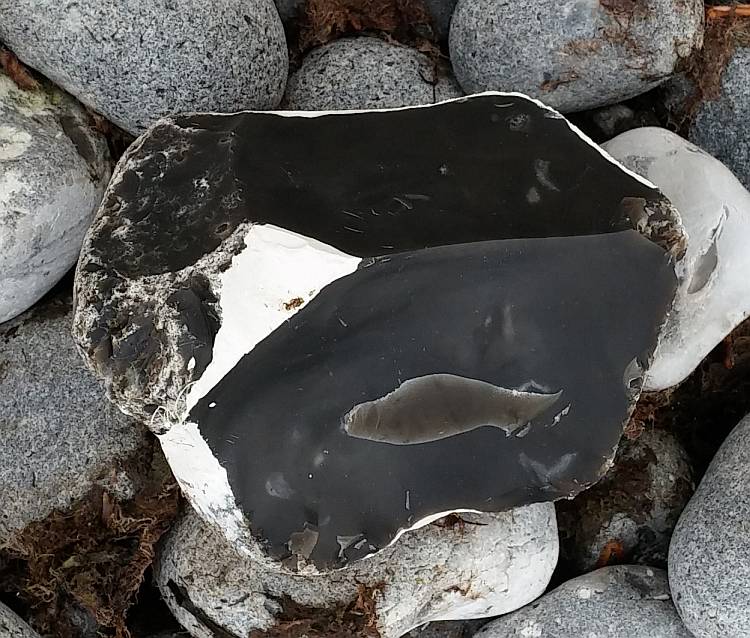
Flint on the coast at Stevns Klint in Denmark. Gray rocks in the background are also flint boulders, but they lack fresh look because of mostly wave-agitated rounding. The boulder in the foreground is freshly broken to demonstrate typical sharp edges of chert which were eagerly exploited by our stone age ancestors.
It is usually either dull or semivitreous. It may have many colors, depending on the nature of impurities. Most common shades are gray, white, blue, green, yellow, black, and red. White coloration is usually given by carbonate impurities; organic matter or clay gives black color; red, yellow, and brown tones are due to hematite, green variety may contain chlorite or smectite from diagenetically altered volcanic tuffs.
It occurs usually as nodules in carbonate rocks, especially well-known are chalks with chert (flint) nodules in Western Europe. This rock is often bedded – rhythmically interlayered with chalk, shale or in some cases hematite. The latter is known as a banded iron formation (BIF) which is the principal iron ore upon which our society relies.
Chert is in most cases a biogenic rock, it is made of siliceous tests of diatoms, radiolarians, siliceous sponge spicules, etc. Sometimes microscopic fossilized remains of these sea creatures may be preserved in these rocks. Their siliceous tests are not made of quartz initially, but after burial, compaction, and diagenesis, opaline siliceous sediments transform to quartz. Although the material it is made of ultimately came from siliceous tests of marine species, the rock itself is often not deposited in situ. It may move as a silica-rich liquid and form nodules in rocks by replacing the original (usually carbonate) material. So chert is also sometimes said to be a rock of chemogenic origin. Bedded variety seems to be often associated with turbidity currents.
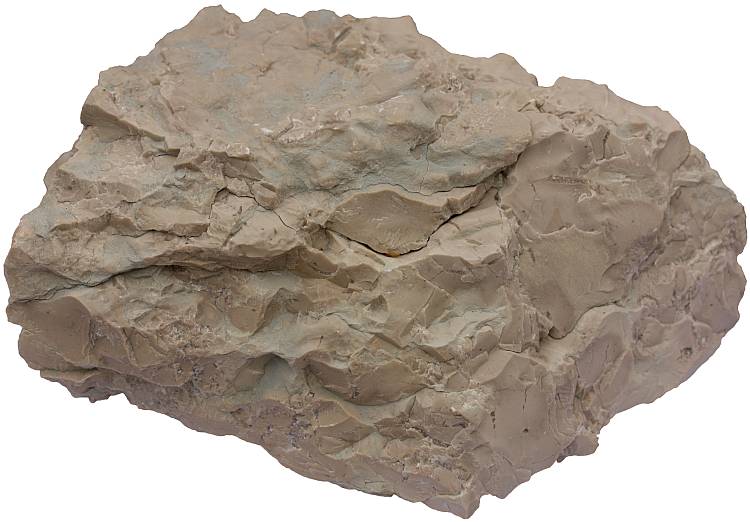
An irregularly shaped nodule from dolomite in Estonia. The width of the sample is 16 cm.
Banded iron formations formed in Precambrian time. The formation of BIF is usually associated with the oxygenation of seawater by photosynthetic cyanobacteria, one of the earliest life forms. Exact knowledge how these old and valuable rocks formed is still lacking. It may also precipitate inorganically directly from hydrothermal solutions.
The term “flint” is essentially synonymous with chert, but its usage is more restricted, at least in geology where “chert” is preferred. Flint is a dark variety of chert for some geologists (especially when it occurs as a nodule in chalk) and semivitreous chert has been named that way. Archeologists also talk about flint when they refer to prehistoric tools made of cherty material.
Chert is a very hard rock and it may splinter when struck with a hammer. Warning on your hammer to wear safety goggles is very much justified if you intend to hammer it.
Pictures
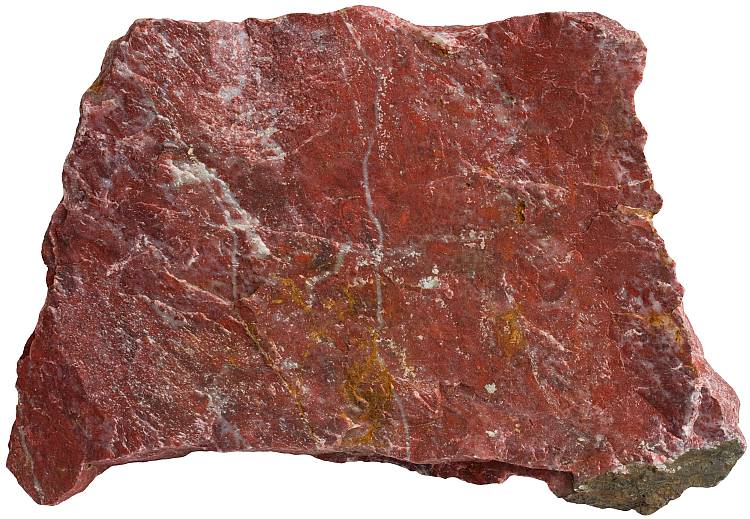
Jasper is a hematite-bearing variety. Hematite is an iron oxide that is the most widespread source of red color in minerals and rocks. The sample is from the Løkken ophiolite in Norway. It is associated with SEDEX-type magnetite-hematite iron ore formed by hydrothermal activity at the spreading zones of mid-ocean ridges. Width of sample 13 cm.
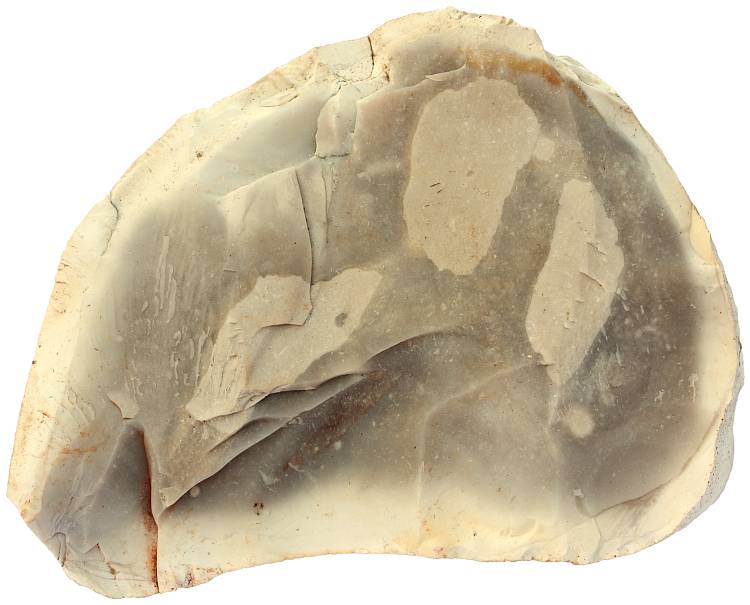
A nodule from Cyprus. The width of the sample is 10 cm.
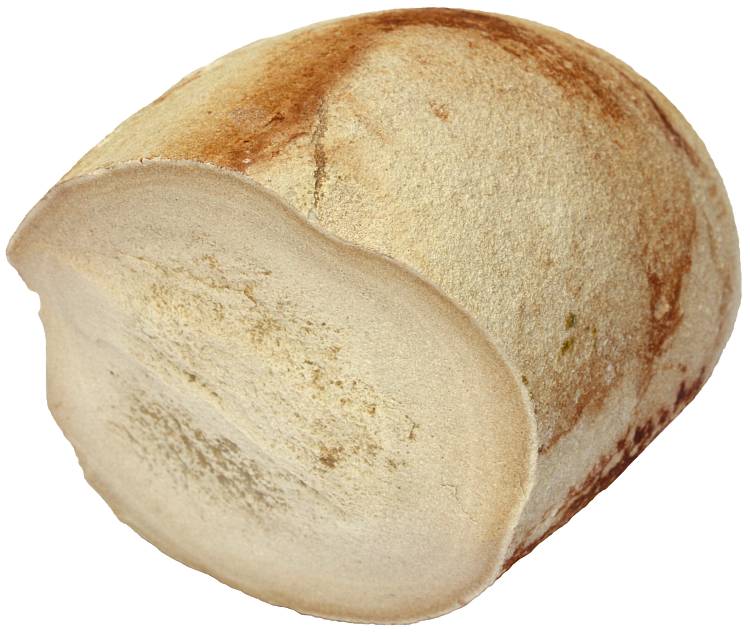
A rounded concretionary nodule from dolostone in Estonia. The width of the sample is 8 cm.
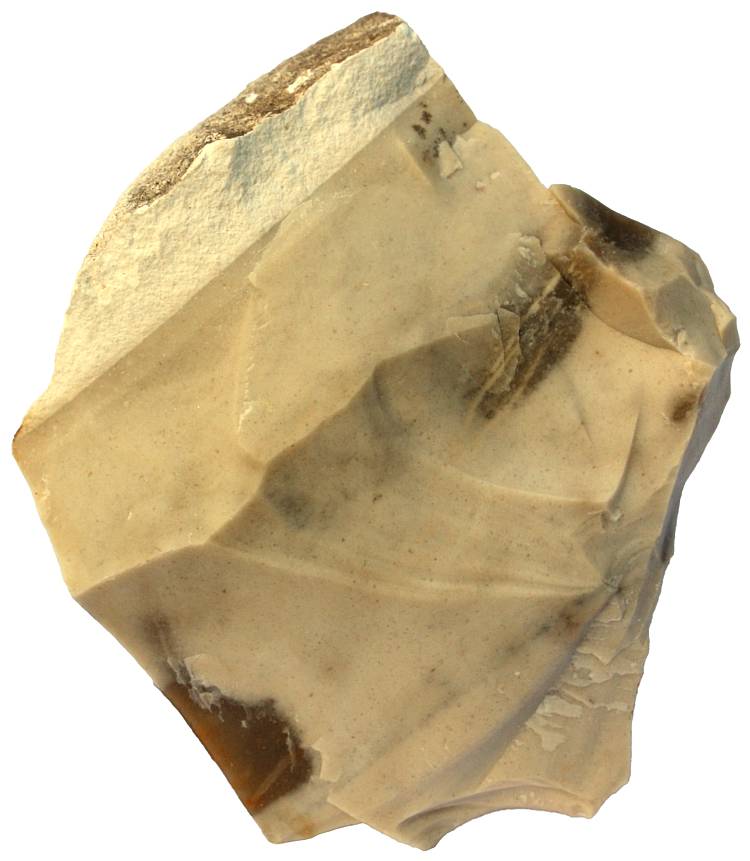
A contact between chalk and chert which exhibits characteristic conchoidal fracture. The width of the sample from Cyprus is 7 cm.
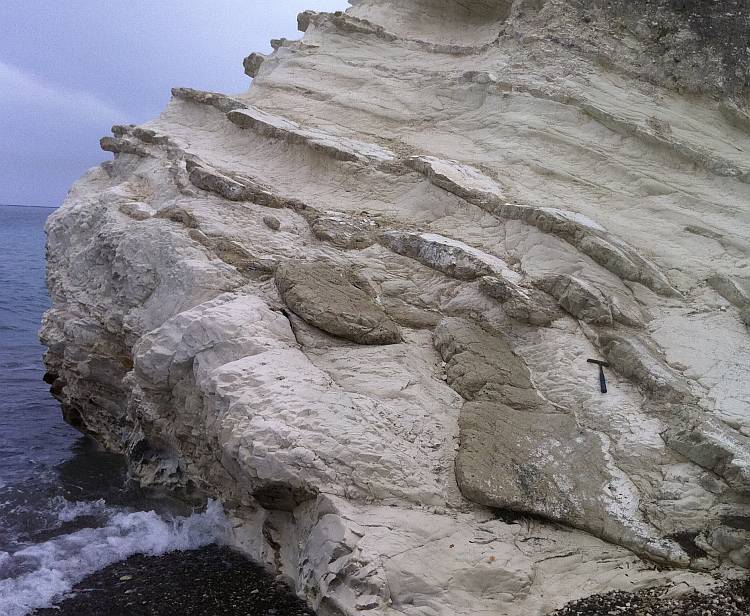
An outcrop of bedded chert and chalk. Governor’s Beach, Cyprus.
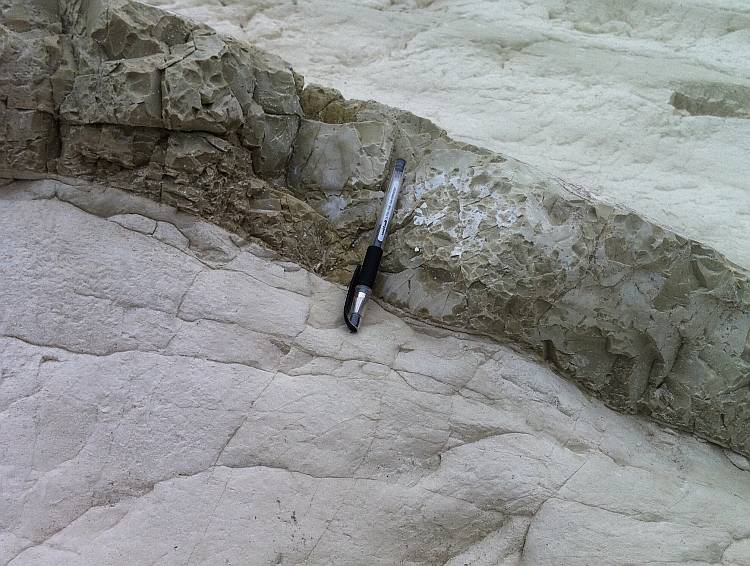
Chert is more resistant to weathering than chalk, so the layers tend to stand out. Governor’s Beach, Cyprus.
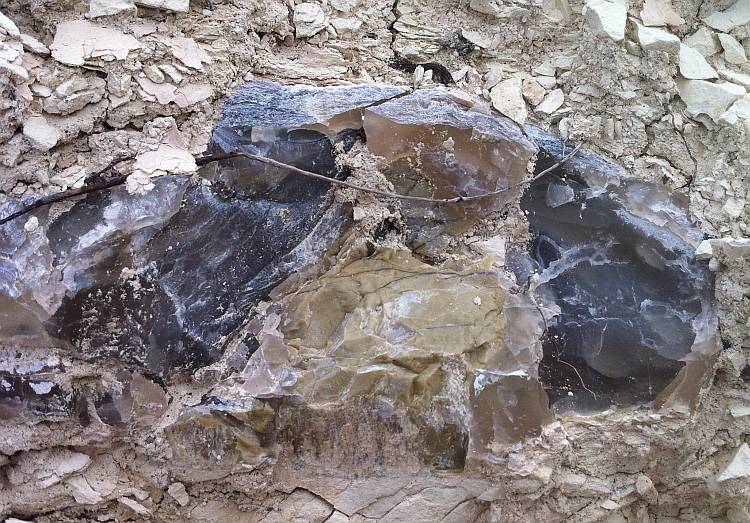
A semivitreous dark-colored nodule (flint) in chalk breccia. Governor’s Beach, Cyprus.
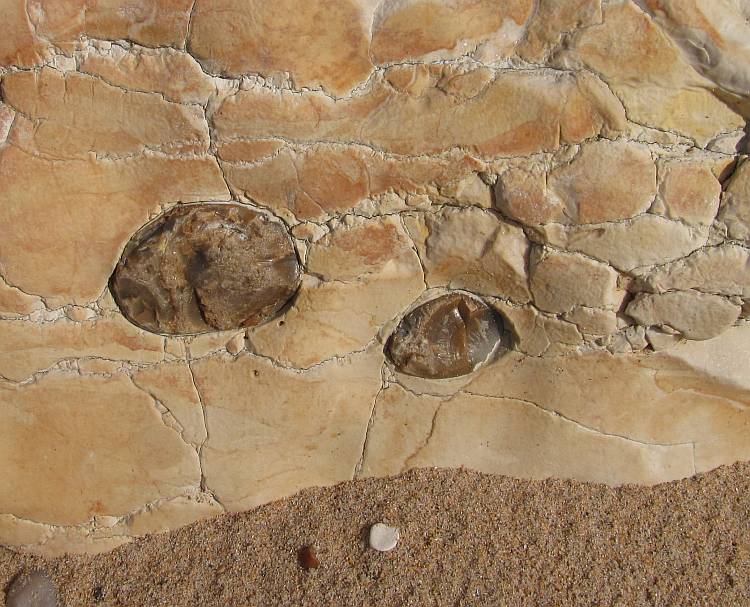
Nodules in chalk. White Park Bay, Northern Ireland.
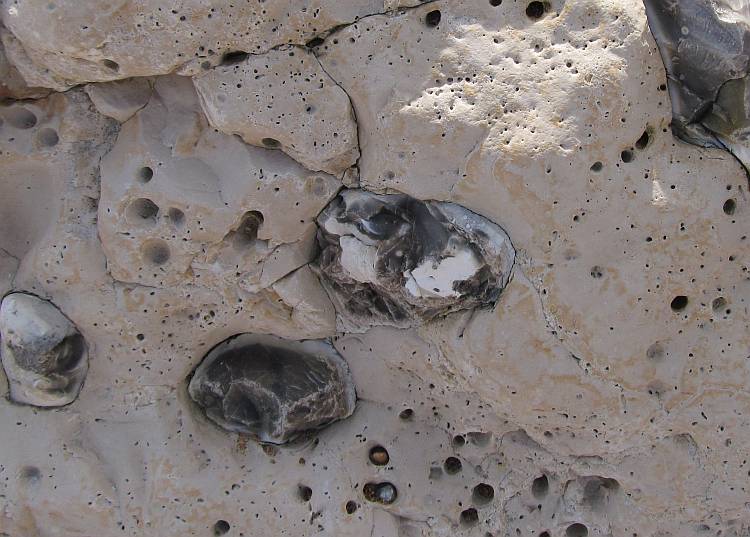
With chalk. Little holes in chalk are caused by tafoni weathering. White Park Bay, Northern Ireland.
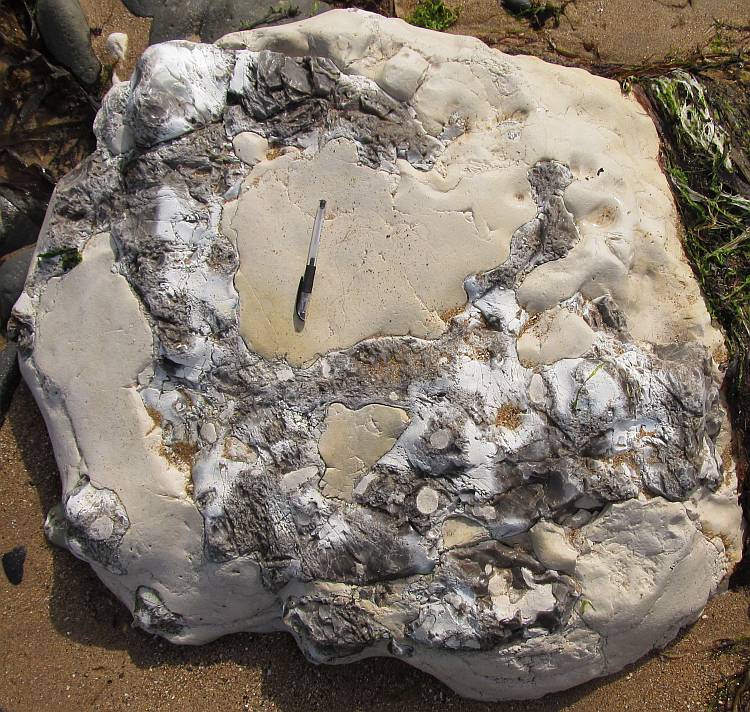
A network of chert in chalk. White Park Bay, Northern Ireland.
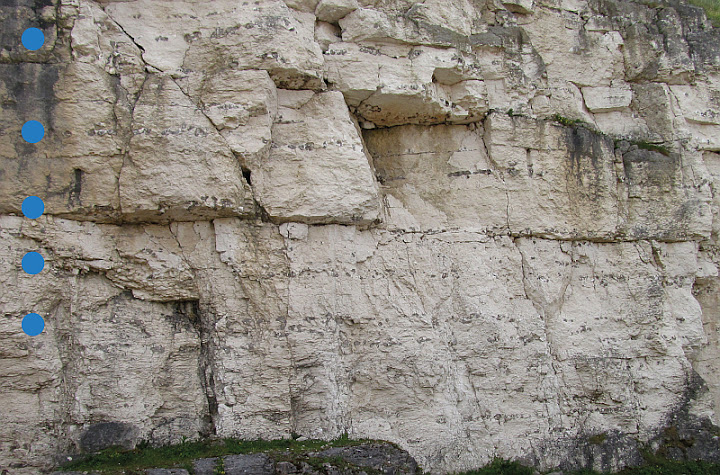
It is evident that although the nodules are diagenetic, their locations still reflect the original deposition layers of siliceous material. I have annotated most prominent layers of chert nodules in chalk with blue dots. Outcrop in a quarry in Northern Ireland.
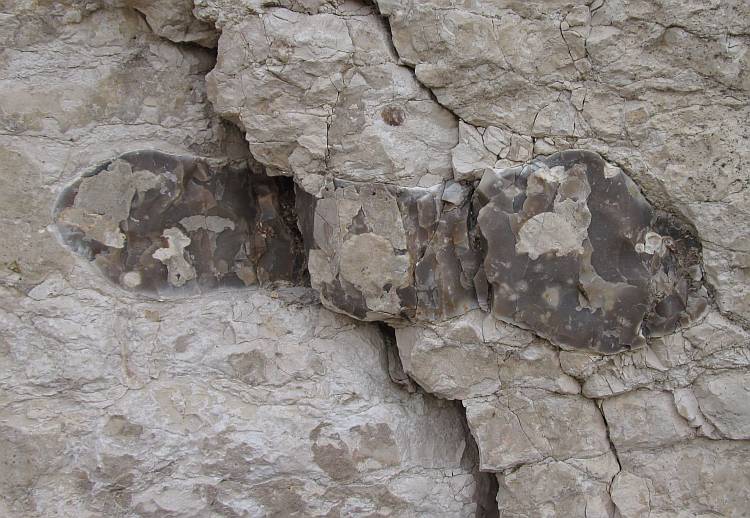
An elongated nodule in chalk. Northern Ireland.
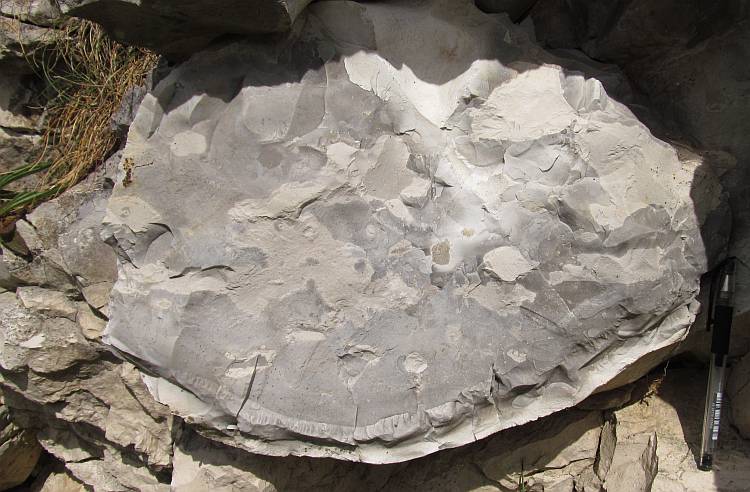
A large chert nodule, 50 cm across, in Northern Ireland.
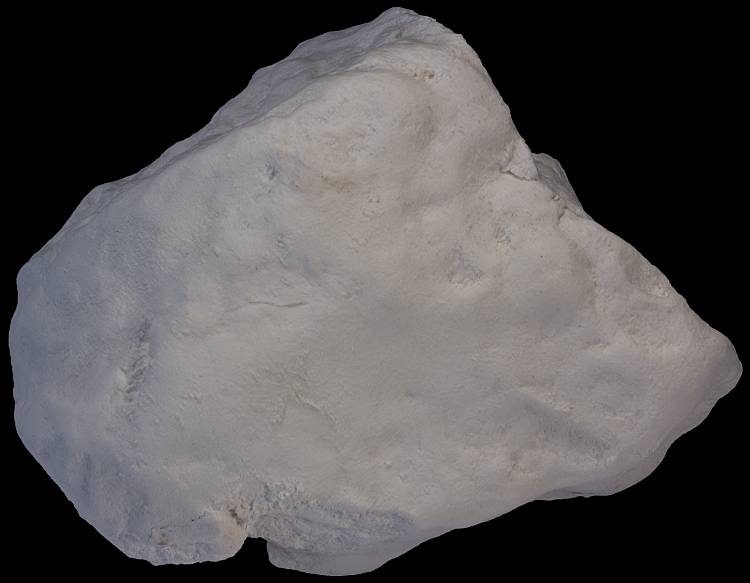
Diatomite (diatomaceous earth) is a soft and very light-weight sedimentary rock that is mostly composed of tiny siliceous shells of diatoms. Diatomite transforms to chert in elevated pressure and temperature conditions. The sample is from Armenia. Width of sample is 7 cm.
Leave a Reply