Kyanite (Al2SiO5) is a common mineral in aluminum-rich (pelitic) metamorphic rocks. Kyanite commonly forms large crystals (porphyroblasts) which usually have a distinct blue color. Its crystals are typically elongated and rectangular or with step-like features which is a typical sign of good cleavage in several directions. In addition to cleavage there is also a good basal parting. The lines running almost perpendicular (85°) to the longer edges are parting cracks. Parting is somewhat similar to cleavage but not every crystal has it and they are created by external stress.
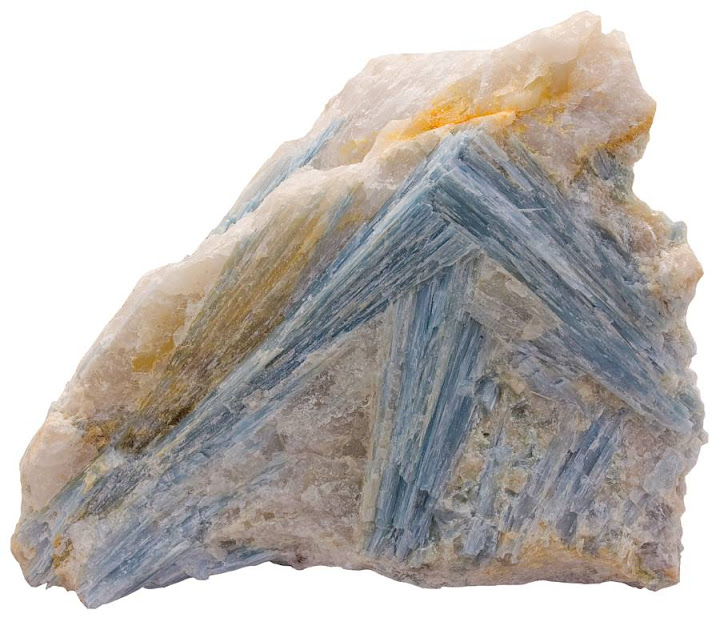
Crystal aggregate with quartz. Kapteeninautio, Finland. Width of sample 11 cm.
Kyanite has an alternative name also — disthene. Both of these names have a meaning relating to the properties of the mineral. “Kyanos” is blue in Greek and disthene (also from Greek) means that its hardness varies. It is considerably weaker along the crystal (5 on Mohs scale like apatite) and stronger across it (7 like quartz).
Kyanite is typically light blue, but not always. It may be white, yellow, or gray. But even black, pink, and green colors are possible. Hence it is not very wise to identify kyanite by its color, although it is a common perception that kyanite is a blue mineral. Beautiful blue crystals may be used as gemstones.
The mineral has several polymorphs. These are minerals that have the same composition, but differ in the crystal structure. These are sillimanite and andalusite. Their composition is quite simple: Al2SiO5 and one may change to another as the metamorphism progresses.
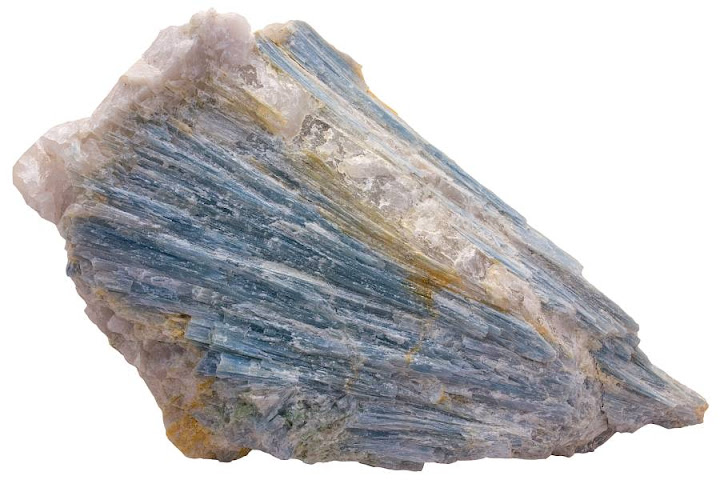
It is usually easy to identify because of elongated tabular crystals that are usually light blue in color. Kapteeninautio, Finland. Width of sample 15 cm.
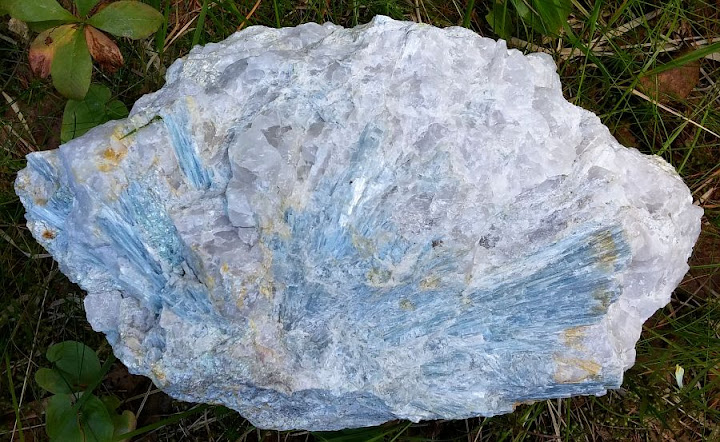
Large sample of kyanite crystals with quartz. Kapteeninautio, Finland. Width of sample 28 cm.
Typical order is andalusite → kyanite → sillimanite, but not always because kyanite tolerates very high pressure but not too high temperature. So it may avoid the sillimanite phase if the temperature is not rising as fast as the pressure does. That may happen in subduction zones, for example. Kyanite is sometimes found in eclogites which are metamorphic rocks of very high pressure. The crystals on the picture below also come from eclogite.
Kyanite is almost always a metamorphic mineral (it is sometimes also found in pegmatites, kimberlites and veins). The rocks containing it were most likely once muddy seabed or something like that. Eclogite, however, is usually metamorphosed basalt or similar rocks. Rocks that most typically contain this mineral are schist and gneiss. It is one of the index minerals of metamorphism. It means that kyanite is used to roughly estimate the conditions (temperature, pressure) that prevailed when these minerals formed. It often occurs together with staurolite, sillimanite, garnet, andalusite, and other metamorphic minerals. It is quite common constituent in sand because its resistance to weathering is good and it is a common constituent of several rock types.
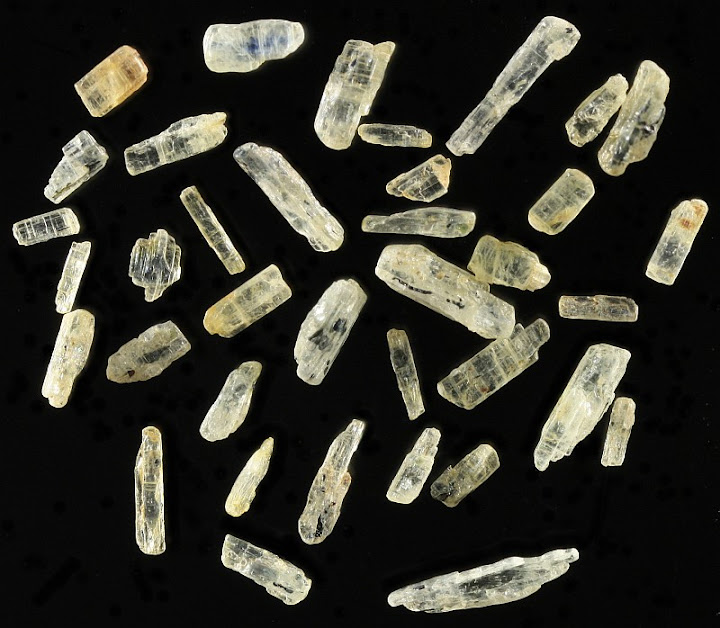
Kyanite crystal picked from a beach sand of Thassos Island in Greece. Width of view 12 mm.
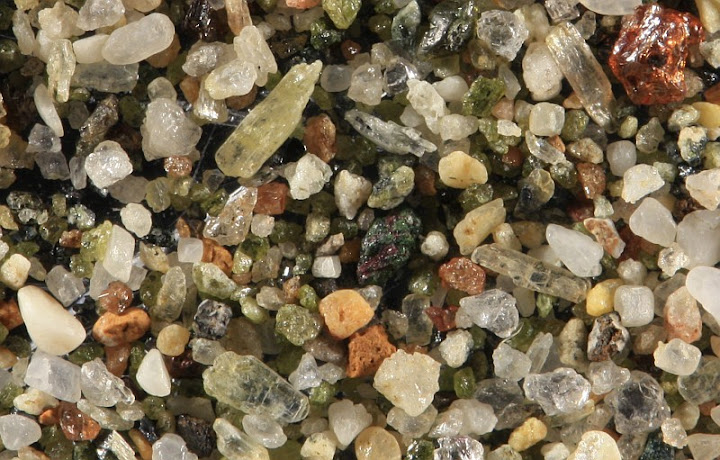
Crystals shown above are picked from this very interestingly versatile beach sand. Other notable minerals it contains are quartz, feldspar, epidote, staurolite, and almandine. Can you spot a grain of eclogite in the middle? Yes, the one with green pyroxene and red garnet. Metalia beach, Thassos Island, Greece. Width of view 9 mm.
Leave a Reply