Rapakivi is a type of granite. Its type locality is the Vyborg batholith which is located in SE Finland and Karelia, Russia. “Rapakivi” is a term that comes from the Finnish language (rotten or crumbled stone) but this rock type is not restricted to this particular area. The magmatic plutons showing rapakivi texture are found in many places all over the world, including USA, Brazil, China, etc.
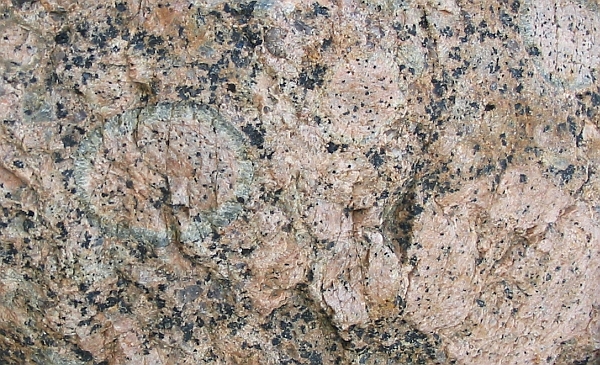
Large orthoclase ovoid (5 cm) mantled by the oligoclase (one of plagioclase feldspar minerals) rim. Not all of the orthoclase phenocrysts are mantled by the plagioclase rims, though. The large ovoid on the lower right lacks plagioclase rim.
This rock is well known for its interesting texture — large ovoidal orthoclase phenocrysts are surrounded by plagioclase mantles. However, not all the rocks that are described as rapakivi granites show this texture. To avoid confusion, rapakivi is now defined as a granite which comes from a pluton that shows rapakivi texture at least partly. The rock with a rapakivi texture from the Vyborg batholith has a special regional name — wyborgite.
Rapakivi from the type locality and its surroundings is approximately 1.6 billion years old. But they are not necessarily restricted to the Proterozoic eon. Rapakivis from the Archaean and the Phanerozoic eons are known as well. The Vyborg batholith is one of the many rapakivi plutons in Northern Europe but most of them are covered by younger layers of sedimentary rocks.
Rapakivi is clearly plutonic rock but the volcanic rocks associated with it most likely existed as well. We have even some examples of very old rhyolitic lavas but most of it is long gone. This volcanic episode must have been very violent and explosive but the evidence is very scarce. The chance for a survival is not very high for a supracrustal rocks of that age. The emplacement of rapakivi plutons and associated rocks (diabase, anorthosite, rhyolite) was probably caused by a rifting episode which subsequently failed. These rocks are therefore anorogenic, their emplacement was not caused by the mountain building episode.
Why is this rock “rotten”? Because it is quite susceptible to weathering. Plagioclase feldspar weathers easily and the inequigranular nature of the rock makes it easier to disintegrate by the temperature changes. The boulders are often so weathered that it takes only bare hands to crumble it into smaller pieces.
Here are some glacial erratics of this type now on the coast of the Baltic Sea near the Vyborg batholith in Karelia.
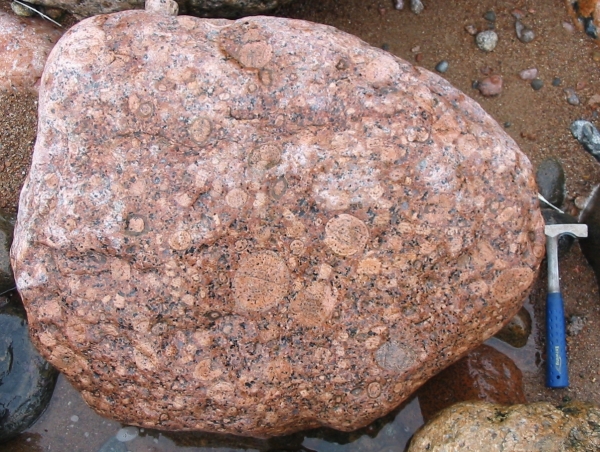
Some orthoclase ovoids are really big (the largest in the middle is 8 cm in diameter). Karelia, Russia (The Gulf of Finland).
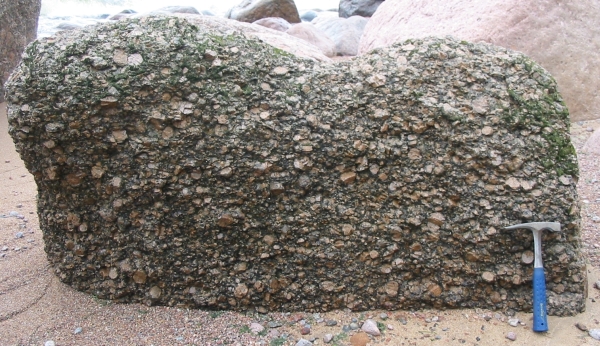
Weathered boulder on the coast of Karelia, Russia (The Gulf of Finland).
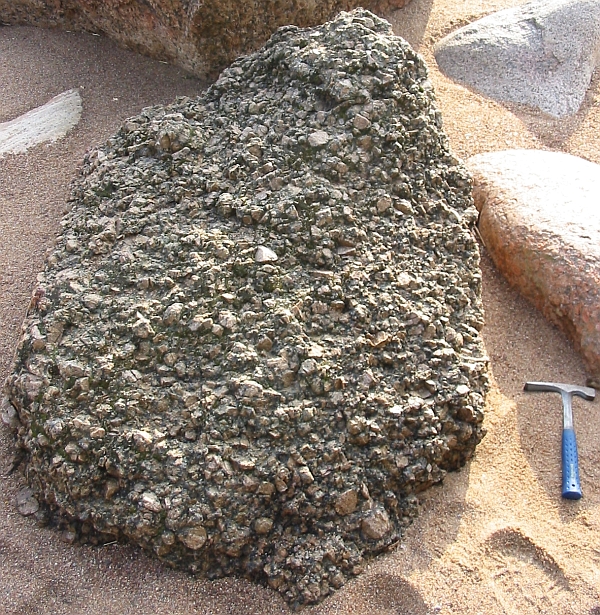
One more crumbled boulder on the Karelian coastline.
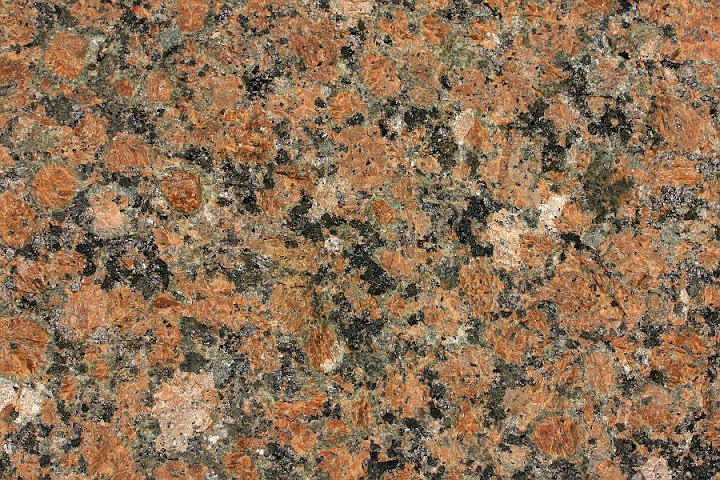
Fresh plagioclase is greenish gray and orthoclase is more close to orange than pink tone. Luumäki, Finland. Width of view 35 cm.
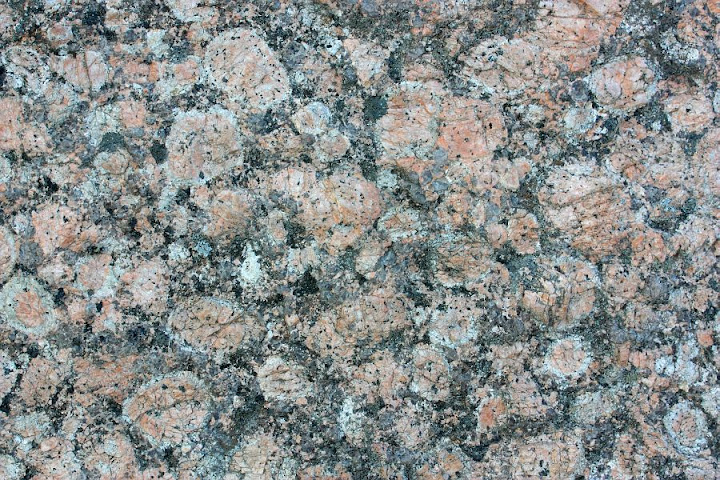
Weathered surface looks different. Plagioclase is light gray which makes the texture more easily noticeable amd orthoclase is also clearly paler pink. Luumäki, Finland. Width of view 30 cm.
We
Here in the USA can this type of sand be found?
Your website is great!
In the US it is generally referred to as decomposed granite. Parts of the Wolf River Batholith near Wausau, Wisconsin have this texture.