Quartz is the most important sand-forming mineral and occurs in very many sand types but usually not exclusively. In this sand type (which is aptly named quartz sand), quartz is almost the sole component of sand. Similar sandstones are called quartz arenites or orthoquartzites.
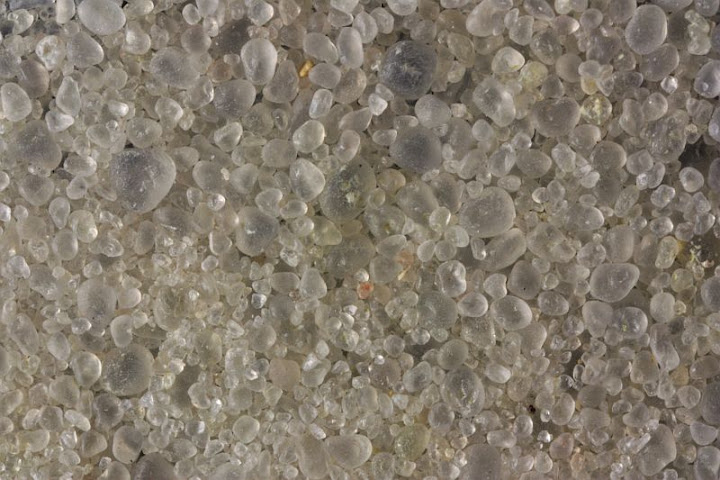
Fine-grained quartz sand from the St Peter formation (Ordovician sandstone) from Minnesota, USA. Sand from this formation is extensively used in hydraulic fracturing (fracking). Width of view 7 mm.
Quartz is the most important sand-forming mineral because it is resistant to both physical and chemical weathering. Sand that is enriched in quartz is likely old (mature) and has traveled far from the source area, sometimes thousands of kilometers. Long journey is required to allow weathering to break down weaker minerals that were initially present in the rocks.
Mineral grains that make up this kind of sand can be very old. They may have broken away from their source rocks millions or even hundreds of millions of years ago and have perhaps seen several lithification and weathering cycles.
Good examples of quartz sand can be found in Florida. Sand from Siesta Key beach is sometimes called the whitest in the world although it has competitors. Quartz sand are found on the coasts of passive continental margins (margins of the continents without active volcanism).
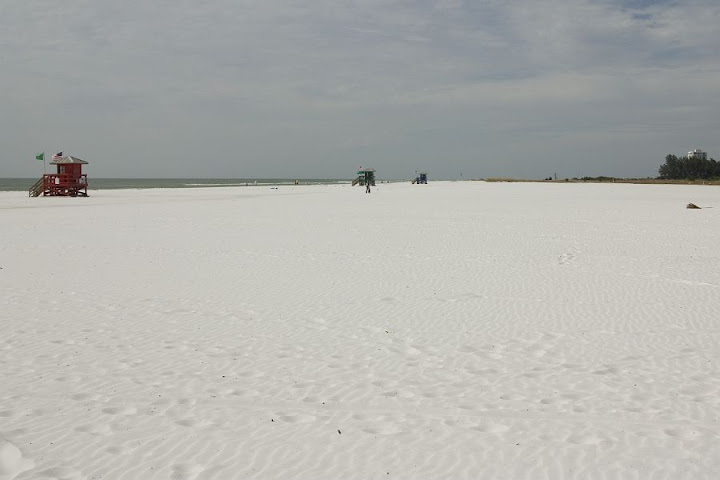
Siesta Key beach sand in Florida is composed almost exclusively of quartz grains.
I live in the Florida panhandle and we have quartz sand on our beaches. However, I have seen black particles, resembling iron dust, near the shoreline of one particular beach. Have an ideas what it could be?
It could be many different things. Perhaps grains of magnetite, ilmenite or tourmaline.