Coquina is a detrital limestone consisting of shells or shell fragments. The constituents are mechanically sorted (usually by sea waves), transported and often abraded because of transport and sorting. It is a porous and soft weakly to moderately cemented rock.
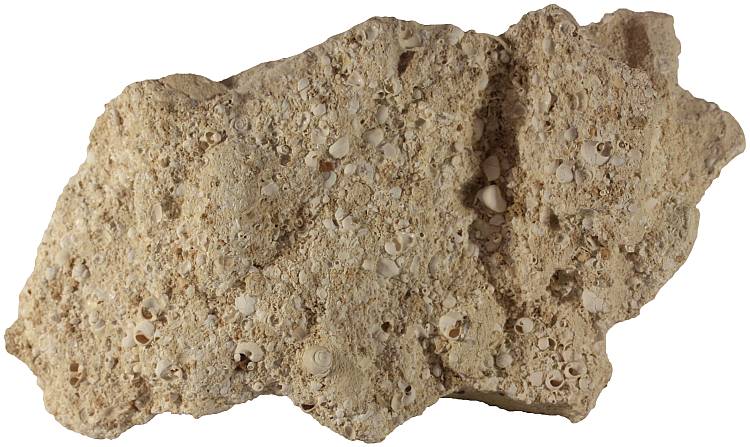
Sample of coquina from Germany. Width of view 14 cm. TUG 1608-4738.
Hard and dense firmly cemented equivalent is coquinite. Coquina could be considered to be a subtype of calcarenite — a detrital limestone of sand-sized clasts (carbonate sandstone) but most examples are composed of clasts that exceed the upper limit of sand-grains size (2 mm). This is not an absolute requirement but generally this rock is imagined to be composed of shells larger than 2 mm (at least partly).
Most samples are composed of invertebrate seashells, usually mollusks (bivalvia, gastropoda). Most coquinas are composed of shells of saltwater organisms but freshwater versions exist as well. Fresh rock is mineralogically composed of aragonite because this is the carbonate mineral mollusks use to build their shells. Coquinite, because it is generally much older, is usually composed of calcite. Some coquinas may be phosphatic if this was the material to build the shells. Coquina does not need to be pure limestone. Silicate minerals, especially quartz, may form part of the rock. However, carbonate grains need to form the majority of the rock. If not, the rock should be named a carbonate sandstone or conglomerate.
Shells forming coquina accumulate in high-energy (shallow water where waves break) environments like beaches, bars, raised banks, etc. The term “coquina” comes from the Spanish and means cockle (edible clams). Coquina occurs in many places all over the world but perhaps the most famous occurrences are in Florida, USA.
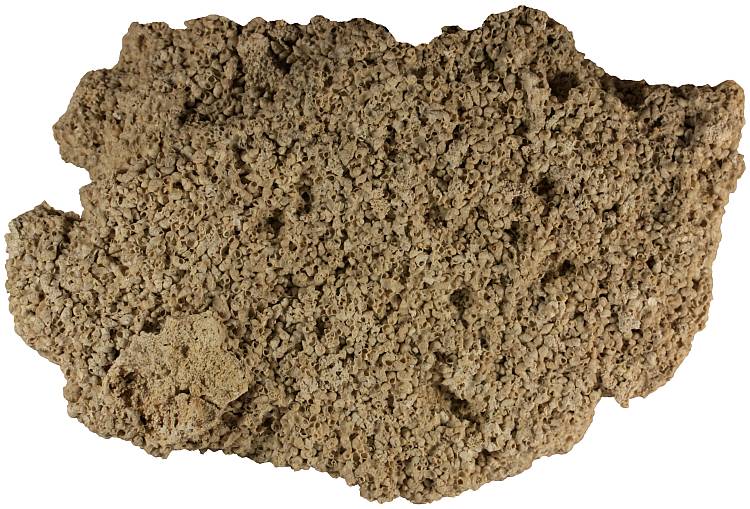
Sample from Germany consisting of gastropod shells. Width of view 13 cm. TUG 1608-2537.
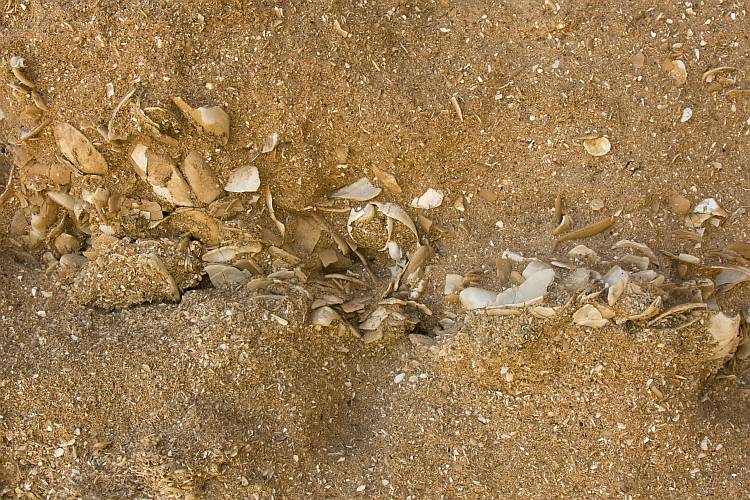
Layer of coquina in a calcarenitic limestone in Morocco (coastal cliff between Essaouira and Agadir). Width of view 40 cm.
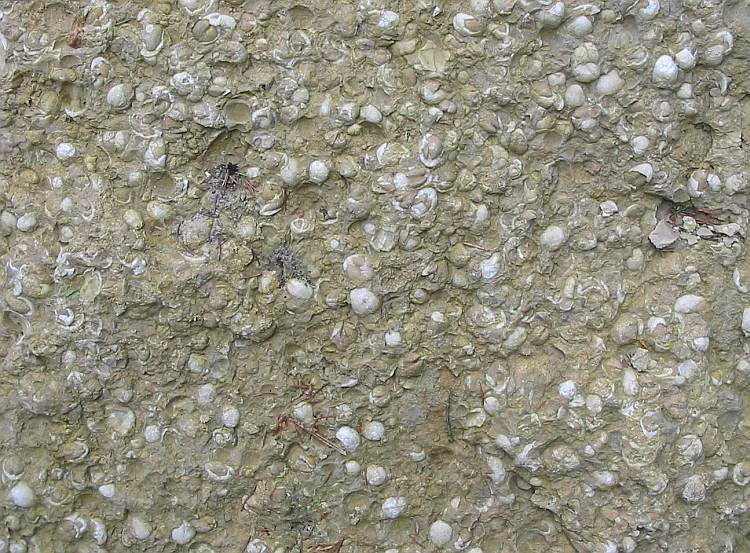
Coquinite from Estonia consisting of Ordovician brachiopod shells (Borealis borealis).
My favorite bit of coquina trivia is Castillo de San Marcos in St. Augustine, Florida. The coquina blocks of the fortress walls absorbed cannon balls without shattering.
http://www.gly.uga.edu/railsback/BS-SA.html
Yes, I’ve read about this fort. There is a nice entry about it in the article about coquina on Wikipedia. Thanks for the link. Parhaps I should add a few lines about this fort.