Globigerina ooze is a soft seafloor sediment composed of microscopic shells of calcareous foraminifera.
Globigerina ooze is white in color and is mostly composed of tests of globigerina. Most foraminifera are benthic (living on the seafloor), but globigerinida (order that contains genus globigerina) are planktonic organisms. They are very small. Picture below is only 5 mm in width. Their fragile tests are composed of hyaline (glassy) calcite.
Globigerina ooze is very common sediment on the seafloor (especially in the Atlantic and South Pacific Oceans), but it is not composed of globigerina tests only. There are other foram taxons as well like Orbulina, Neogloboquadrina, and Rotaliida.
Globigerina ooze is a calcareous sediment. Such sediments generally do not survive below the calcite compensation depth (CCD). The CCD in average is about 4500 meters below sea level. Below that level calcite dissolves in seawater. The forams on the picture below come from the Weddell Sea which is bordering Antarctica. The sample is taken 3500 meters below the sea level. I thank Michael Hesemann from foraminifera.eu for sending me this sample.
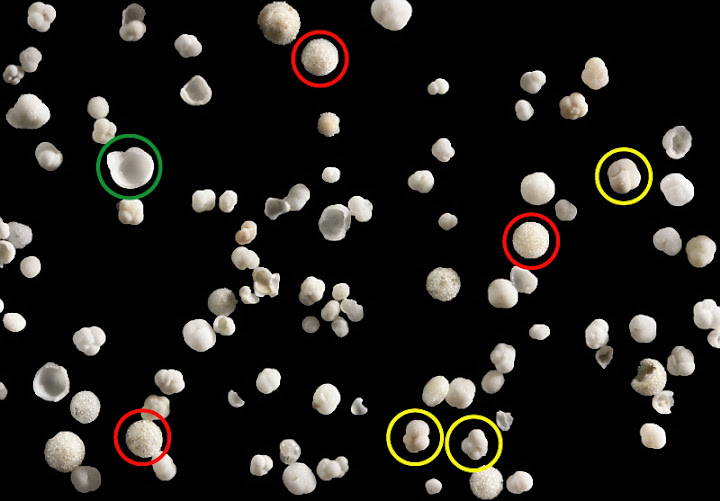
Forams of globigerina ooze covering the seafloor of the Weddell Sea (3500 meters below sea level) near Antarctica. Red circles are around Orbulina universa, green could be Rotaliida, and yellow ones are Globigerina but some of them may be Neopachyderma also. The width of the view is 5.1 mm.
Leave a Reply