Heavy minerals are minerals with a density greater than 2.8…2.9 g/cm3. Why these numbers and what for is this range needed? Why not just one number? The most common minerals in most sand samples are quartz and feldspar. Calcite and dolomite are common cementing minerals in sandstones. All of these minerals have densities below the range shown above. Heavy minerals are usually volumetrically insignificant. However, there are a large number of heavy mineral species, each of them having their own story to tell. Therefore geologists often need heavy minerals to get as much information out of the studied rock as possible.
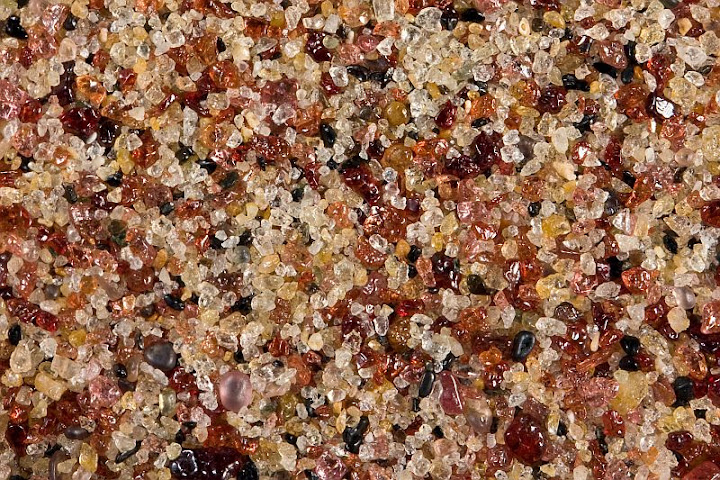
Heavy minerals in beach sand from Sri Lanka. Most intensely colored grains are spinel crystals. Width of view 20 mm.
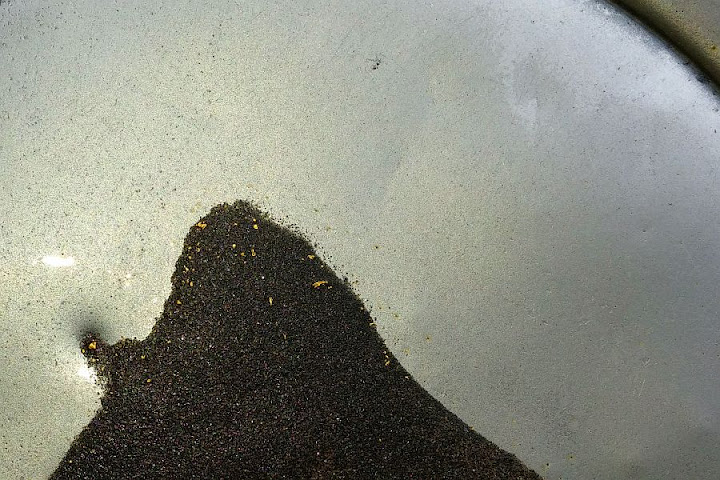
Heavy minerals including gold on a gold pan. This concentrate is panned from river sediments in Lapland, Finland.
It is very uncomfortable to do if only one grain out of one hundred or less is what we are looking for. We therefore seek methods to somehow separate heavy minerals from the bulk of the sand. Obvious way to do that is to use some heavy liquids which have a density greater than that of quartz (2.65 g/cm3) but lighter than that of most minerals.
Several liquids with slightly different densities have been used. That’s the reason why there is range instead of fixed value. The liquid used to separate heavy minerals from the rest is usually bromoform (its density is 2.89 g/cm3). It is liquid at room temperature and feels abnormally heavy as one is usually not used to liquids as dense as bromoform. Its high density is a result of three bromine atoms in its chemical formula (CHBr3). This liquid has a nasty downside. It is poisonous and has a disgusting odor. I guess it is actually a good thing because you don’t want to be exposed to the vapors of it. There are some more recently developed alternatives though which do not have such an adverse health effects, most notably polytungstate liquids.
Heavy minerals are useful to study the provenance of a sand or sandstone. “Provenance” is a fancy term geologists love to use when they talk about the place where the sand grain broke out of its parent rock and began its journey as a sediment particle. How do we study provenance? We take a look at the heavy mineral fraction and make sure what is its composition. Let’s say it contains garnet, staurolite, and kyanite. What can we say about that? I think we can reasonably safely assume that this sand is a weathering product of a metamorphic terrane because this mineral assemblage is very typical to metamorphic rocks. If there are lots of augite, magnetite, and olivine, then it probably comes from an igneous source.
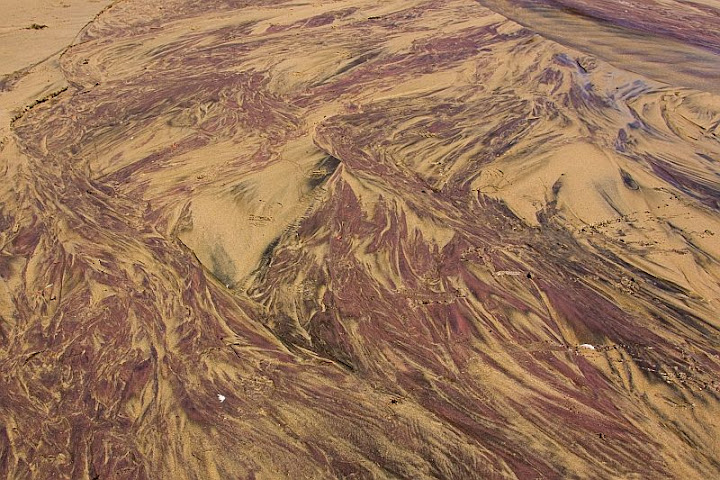
Heavy minerals are sorted out by a running water near the coastline at Pfeiffer Beach, California.
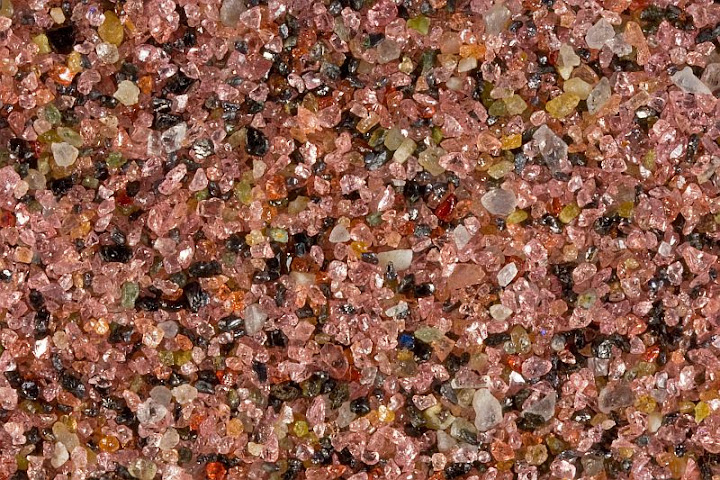
A closer look at the Pfeiffer Beach sand. Main heavy mineral species are garnet, epidote, zircon, magnetite, spinel, staurolite, etc. Width of view 8 mm.
It is a very broad approach. Unfortunately more detailed studies into the provenance often give debatable results because there are so many factors that can alter the composition of the heavy mineral suite. These are mostly weathering, burial diagenesis, hydrodynamic sorting, and mechanical abrasion during the transport.
Heavy minerals in beach sand from Sri Lanka. Most intensely colored grains are spinel crystals. Width of view 20 mm.
Many diamond-bearing kimberlite pipes are discovered by studying heavy mineral fraction of a sand. We need to look for pyrope (which is heavy mineral) for example. This is a rare Mg-bearing garnet that is associated with diamonds in kimberlite pipes. Its presence in the river sand may give us a hint that a kimberlite pipe may be nearby. To hunt down its location, we have to go upstream and take many samples until pyrope and some other index minerals found in abundance in kimberlite pipes suddenly disappear. Heavy minerals have other applications in forensics, oil and gas industry, etc.
Heavy minerals sometimes get naturally concentrated as a heavy mineral sand and there were, of course, no bromoform involved. It was moving water either in a stream or beach that did the job. Sometimes the sand is so concentrated in heavy minerals that it has a real economic value as an ore. Sand collectors also love these black sand deposits. Such heavy mineral concentrates are called placers.
Gold panning is an activity used to separate gold flakes and nuggets from these placers. However, gold is not the only mineral that is mined from placers. These minerals are also cassiterite (tin ore), ilmenite (titanium), magnetite (iron), rutile (titanium), monazite (rare earths), chromite (chromium), zircon (zirconium), etc. Australia is particularly well-known heavy mineral source, but heavy mineral deposits occur in many places.
Some common and not so common heavy minerals in sand and some of their properties:
| Mineral | Density | Stability in weathering | Stability in diagenesis | Provenance |
|---|---|---|---|---|
| Anatase | 3.82…3.97 | High | High | Felsic igneous rocks, hydrothermal veins, alteration product of titanite or ilmenite. |
| Andalusite | 3.13…3.16 | High | Low | Metamorphic rocks. |
| Amphibole | 3.02…3.50 | Low | Low | Igneous and metamorphic rocks. |
| Apatite | 3.10…3.35 | Low | High | Igneous and metamorphic rocks. |
| Cassiterite | 6.98…7.07 | High | Felsic plutonic rocks, hydrothermal deposits. | |
| Chloritoid | 3.51…3.80 | Moderate | Moderate | Metamorphic rocks. |
| Chromite | 4.43…5.09 | High | Mafic and ultramafic igneous rocks. | |
| Clinopyroxene | 2.96…3.52 | Low | Low | Igneous and metamorphic rocks. |
| Corundum | 3.98…4.02 | Silica-poor igneous rocks, pelitic metamorphic rocks, hornfels, metamorphosed carbonates, mafic igneous rocks. | ||
| Epidote | 3.12…3.52 | Low | Low | Mostly metamorphic rocks, less in igneous rocks. |
| Garnet | 3.59…4.32 | Moderate | Moderate | Mostly metamorphic but igneous also. |
| Ilmenite | 4.70…4.79 | Igneous and metamorphic rocks, sometimes hydrothermal veins. | ||
| Kyanite | 3.53…3.65 | High | Moderate | Metamorphic rocks, rarely in igneous rocks. |
| Magnetite | 5.17…5.20 | High | Igneous and metamorphic rocks, hydrothermal veins. | |
| Monazite | 5.00…5.30 | High | High | Igneous and metamorphic rocks. |
| Olivine | 3.22…4.39 | Low | Low | Mostly mafic and ultramafic igneous rocks, some metamorphic rocks also. |
| Orthopyroxene | 3.21…3.96 | Low | Low | Mafic and ultramafic igneous rocks, high grade metamorphic rocks. |
| Pumpellyite | 3.18…3.23 | Metamorphic rocks. | ||
| Rutile | 4.23…5.50 | High | High | Igneous and metamorphic rocks. |
| Sillimanite | 3.23…3.27 | High | Low | Metamorphic rocks, sometimes granite. |
| Staurolite | 3.74…3.83 | High | Moderate | Metamorphic rocks. |
| Titanite | 3.45…3.55 | Moderate | Moderate | Igneous and metamorphic rocks. |
| Topaz | 3.49…3.57 | Felsic igneous rocks, metamorphic rocks. | ||
| Tourmaline | 3.03…3.10 | High | High | Granitic pegmatites, some metamorphic rocks. |
| Xenotime | 4.25…5.10 | High | High | Igneous and metamorphic rocks. |
| Zircon | 4.60…4.70 | High | High | Igneous and metamorphic rocks. |
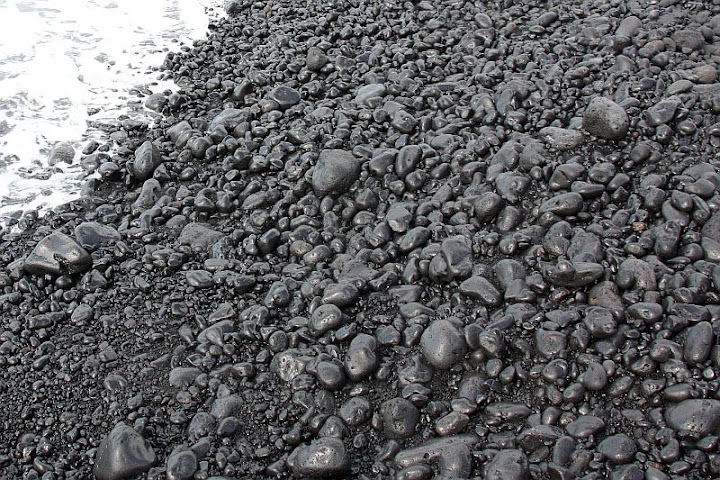
Basalt is full of heavy minerals. Here are basalt pebbles going through the weathering processes on the coast of La Palma, The Canary Islands.
Further reading
Deer, W. A., Howie, R. A. & Zussman, J. (1996). An Introduction to the Rock-Forming Minerals
I am hosting a soil examination workshop next month. Where can I obtain sands or separates with the minerals listed above for mounting on slide for microscopic examination. Who should I turn to as I have asked many a person….a few have a few but I’d like to find someone or two who have many of those listed above…especially interested in epodite, tourmaline, kyanite, sillimanite, olivine, apatite and amphibole….. You can also e-mail me at home davidbflohr@bellsouth.net but please let me know your e-mail is in response to this post so I don’t consider it spam and delete it. Thanks, nice site.
David
David, this is a very good question but I am afraid there is no good answer. I’ve turned to several people with the same question. There are lots of mineral dealers who sell beautiful specimens but I am especially interested in sand-sized grains. Unfortunately I haven’t found anything like that so far. So my approach is to swap sand samples with sand collectors. Then I examine them with microscope and if there are something interesting, then I painstakingly pick the grains out of the sand, take photos and publish them here in my website. Crushing rocks and picking minerals out of the mixture is an option also. Needless to say, both approaches are very time consuming. The demand for such material seems to be so weak that it makes no sense for anyone to offer it for sale.
hi..i collect sand..mostly heavy mineral sands from california, ..i pan streams looking for gold and platinum/// i now have developed slow careful panning to get rid of quartz, feldspar, but keep the rest.i dry it carefully in the microwave, then remove the magnetite with a rare earth magnet by holding it above the dry sand and letting the magnetite jump out onto the magnet…i clean the magnet, and again start on the remaining heavy concentrates, actually touching the sands, and amazingly, they adhere , but just a thin crust, so many repeat removals need to be done ..this is the ilmenite, and chromite, and garnet fraction..if the garnet has iron….the remainder contains gold, sphene, zircon, and small flakes of iridium, platinum.(merced river,california).i then separate this using a tiny 4 inch wide shallow gold pan, using jet dry, and make a tail by usual panning method, rotating the pan a little with each shake until all is nicely separated. I save each pan,let it dry, then view under 40 powerwith a stereo microscope.i can mount any grain by picking it up, and placing on a glass slide along with finger nail polish to hold it secure..this slide i can send to anyone who is interested, ….i recently have found a lot of partially rounded,elongated pale red-purple crystals along with my micron gold flakes from the feather river..would be interested in the identification, as this is unique,not found in all of the other rivers of california.
you actually gave me a solution to my problem,thanks.I’m just a student.nice site
Hey great site guys. We have just had some of our sand analysed by XRF and have found it to contain palladium, Gold, silver, niobium Tantalum ,Zirconium Zinc,Iron Nickel and aluminium . these are obviously very low percentages but if we worked this sand in volume it seems it could be viable. Any Ideas on how to go about this?? I believe the palladium does not exist on its own it is in conjunction with another mineral
regards Mark
hello
my name is mahdi gholamdokht bandari.i live in iran banddar abbas.ihave work chemical sedimentology deposits coastal hormoz island.i need books related whit chemical sedimentology .gold my in work at the hormoz recognaized heavy mineral .chemical compaction.very tanks
Hello, Mahdi
This one maybe:
http://www.amazon.com/Heavy-Minerals-Volume-Developments-Sedimentology/dp/0444517537/ref=sr_1_1?ie=UTF8&qid=1368019781&sr=8-1&keywords=heavy+minerals+in+use
I have some round clear bottles embossed National bureau of Standards/black screw plastic lids in cardboard tubes with labels from Department of commerce Bureau of standardsa Washinton standard sample.they are all different like Argillaceous Limestone, Low-boron glass, Flint clay, etc. All are dated on bottom of cardboard tubes–mostly 1950″s. I do not know if there is a market to sell these or do I take to garabage disposal or??? would appreciate any help on this. Have 17 with tubes and 3 with just bottle. All have sample in the jars but not filled by any means,just sample. Thanks for any help
can anyone assist.
I need the ratio of water to solids for testing Turbidity on chrome ore fines samples.
There seems to be no one who does this turbidity testing???
Leanne