Magnetite (Fe3O4) is a common iron oxide mineral. It is a member of the spinel group. These are minerals that share the same structure but differ in chemical composition. Other notable members of the group are chromite and spinel. Magnetite is among the two major sources of iron. The other important iron-bearing mineral is hematite.
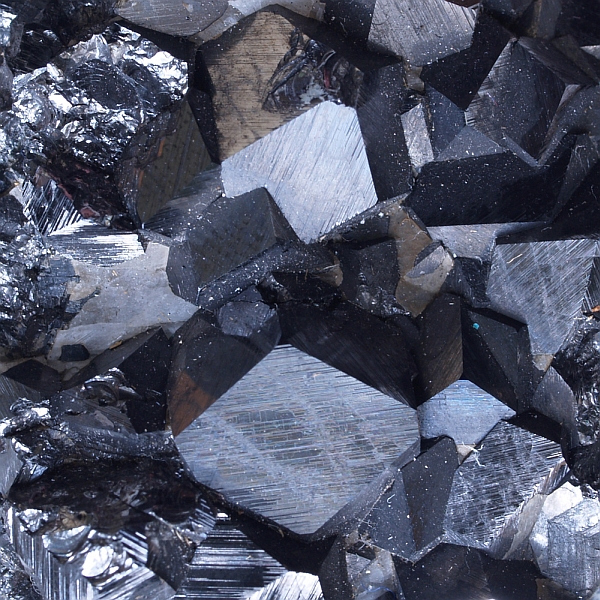
Crystals of magnetite are opaque with slightly bluish black color. Width of view 25 mm.
Composition
More precise way to express the chemical composition is to differentiate between di- and trivalent iron: Fe2+Fe23+O4. However, this is the ideal end-member composition. Real crystals found in nature almost always contain variable amount of Al, Cr, Mn3+, and Ti4+ substituting for Fe3+ and Ca, Mn2+, Mg replacing Fe2+. Titaniferous variety is named titanomagnetite. The term has been applied somewhat loosely, but it is best to restrict it to those varieties where the ulvöspinel phase can be demonstrated by X-ray analysis1. Ulvöspinel is an end-member of the spinel group with the following composition: Fe22+TiO4.
The composition expressed as Fe3O4 may cause some confusion. Oxygen has an oxidation state of -2, and iron usually have oxidation states of +2 or +3 (ferrous and ferric iron, respectively). To form a crystal, these oxidation states must balance or cancel each other out but 4 × -2 = -8 which is not balancing 6 (2 × 3) or 9 (3 × 3). Is there an error in the formula?
Not really. To overcome this problem it is useful to treat it as a mixture of two iron oxides with oxidation states of +3 and +2 respectively (Fe2O3 and FeO) which are combined in a certain way and form magnetite crystals. It is important to understant that magnetite is not a mixture in the strict sense. It is a crystalline solid in which different iron atoms are chemically combined with oxygen atoms.
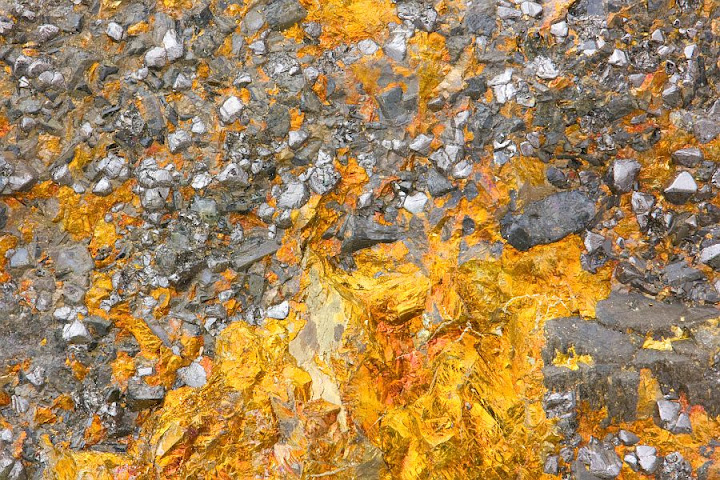
Magnetite (grayish black) showing typical octahedral crystal shapes. Yellow mineral is chalcopyrite. Width of view 30 mm. Skarn-related polymetallic ore deposit. Hannukainen, Finland.
Properties
The most striking property of magnetite is very strong ferrimagnetism. It makes the mineral easily identifiable because it is strongly attracted to a hand magnet. Ferrimagnetism is caused by opposing, but unequal magnetic moments within the crystals which results in permanent and spontaneous magnetization of the material.
The presence of di- and trivalent iron in the crystal lattice is the reason why magnetite is so strongly magnetic. Divalent (+2) and trivalent (+3) iron have unequal magnetic moments that are not balancing each other. Magnetite is the most magnetic mineral.
High iron content gives magnetite its opaqueness and black color. Spinel which shares the same structure is variably colored and transparent because it contains magnesium and aluminum instead or iron.
Magnetite is dense (specific gravity 5.20) mineral. This is considerably above common silicate minerals (usually 2.5–3.5) which is why rocks containing appreciable amount of magnetite feel heavy in hand sample. Hardness is about 6 on the Mohs scale. Magnetite has no cleavage but parting may be distinct. Crystals are brittle and fracture is uneven.
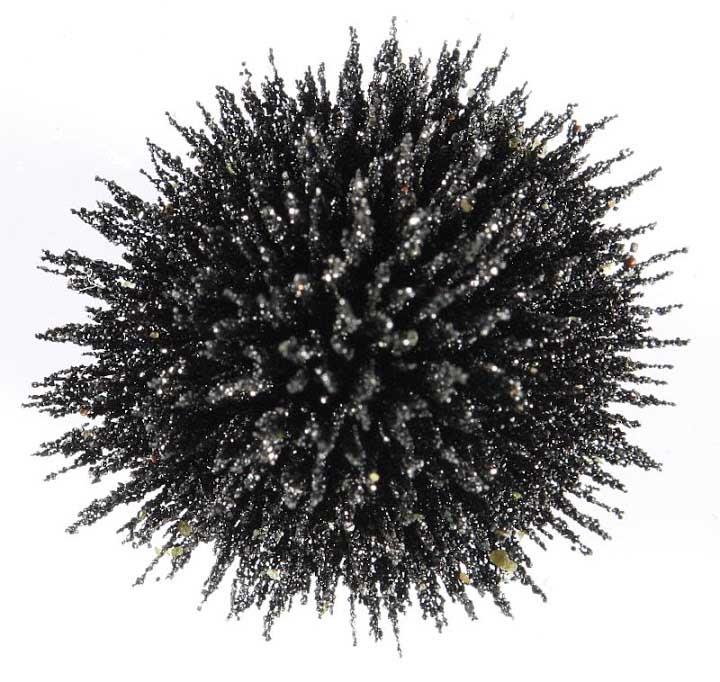
This is how magnetitic sand aligns itself in the presence of a strong external magnetic field. There is a neodymium magnet placed beneath the sample. Crystals from Talofofo Beach, Guam, USA. Width of view 10 mm.
Occurrence
Magnetite is a very common (but usually accessory) mineral in igneous and metamorphic rocks. It occurs in a wide variety of igneous rocks as small octahedral or anhedral grains. It may form larger segregations in contact-metasomatized carbonate rocks (skarns) where it is associated with calcite and calc-silicate minerals like diopside, andradite, actinolite, tremolite, etc.
Massive variety may also occur in some mafic layered intrusions. It may form in regionally metamorphosed rocks where it forms at the expense of iron hydroxides (goethite, limonite) and oxides (hematite).
It is the main iron-bearing mineral in the oldest Algoma-type banded iron formations where it is associated with chert.
Magnetite is among the most common minerals in heavy mineral fraction of sand. Its grains in sand are generally much smaller than lighter mineral grains because of different settling velocity. Most magnetite grains in sand are rounded but some show characteristic octahedral morphology. It is never elongated because of cubic (isometric) crystal system.
Magnetite is common in sand because it is abundant in many rock types and it is also moderately resistant to weathering. In some places beach sand may be so concentrated in magnetite that it could be used used as an iron ore. In New Zealand a sand deposit called Ironsand is used to make steel.
Magnetite is altered in the weathering environment to hematite, goethite or other iron oxides and hydroxides. Martite is a pseudomorphous hematite after magnetite.
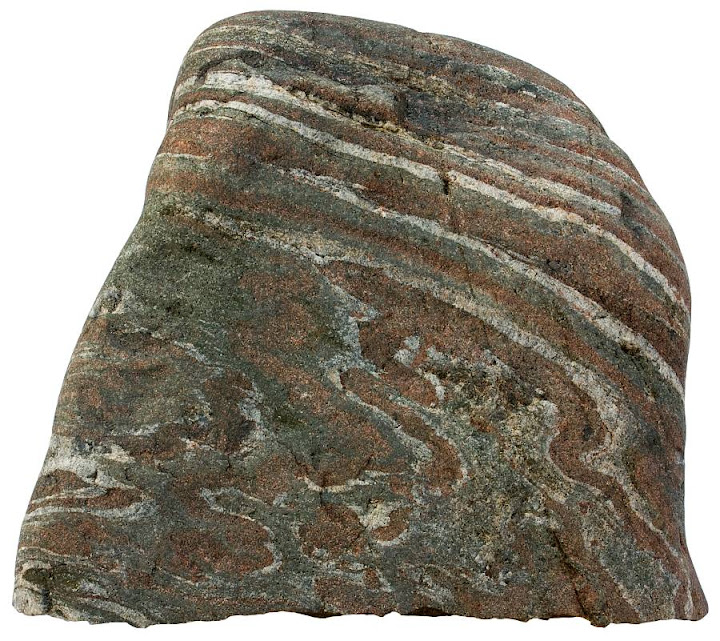
Magnetite is a common heavy mineral in sand. This rock is a metamorphosed sand deposit which seems to be very rich in heavy minerals magnetite (black) and garnet (red). Varanger Peninsula, Northern Norway. Width of sample 18 cm.
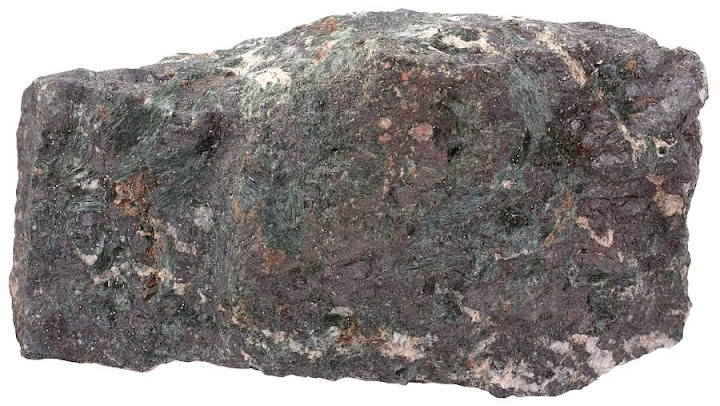
Actinolite (green) with magnetite and calcite. Kiruna, Sweden. Width of sample 8 cm.
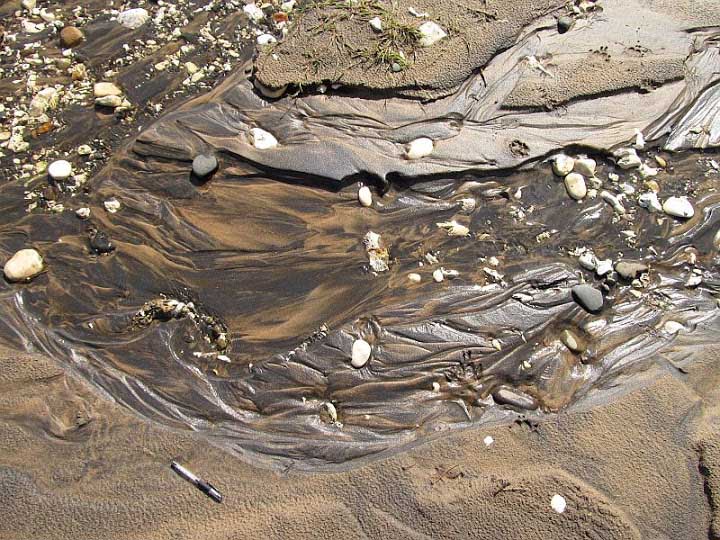
Magnetite crystals forming black stripes in light-colored sand. It is one of the most common constituents of heavy minerals in sand. White Park Bay, Northern Ireland.
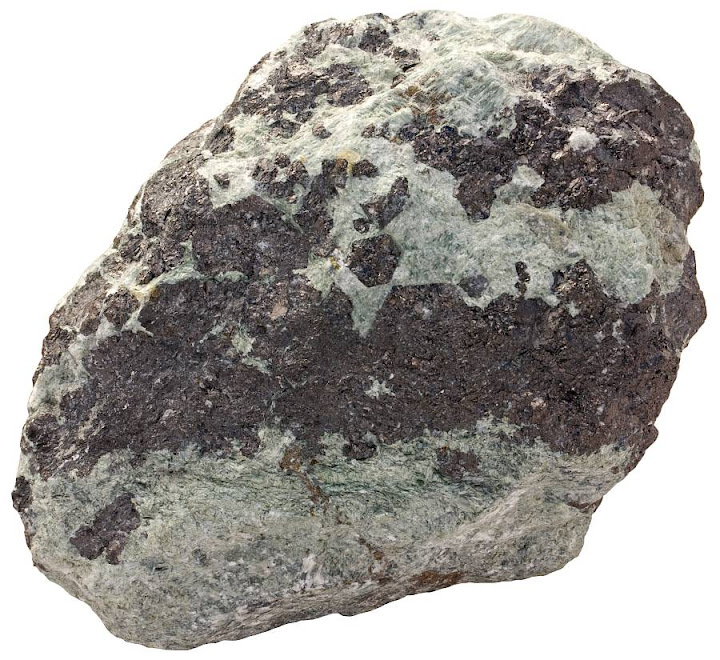
Magnetite with amphibole group mineral tremolite in skarn. Skarn is a contact-metasomatic rock. It forms when hot silicic magma comes to contact with carbonate country rocks (dolomite, limestone, marble). The result is unusual assemblage of calc-silicate minerals like tremolite, diopside, andradite, wollastonite, etc. These rocks also frequently contain ore minerals because late-magmatic fluids are usually enriched in incompatible chemical elements that have no place in the crystal structure of common magmatic minerals. Skarn was originally a miners term for the gangue minerals (calc-silicates) surrounding the ore veins. Width of sample 8 cm.
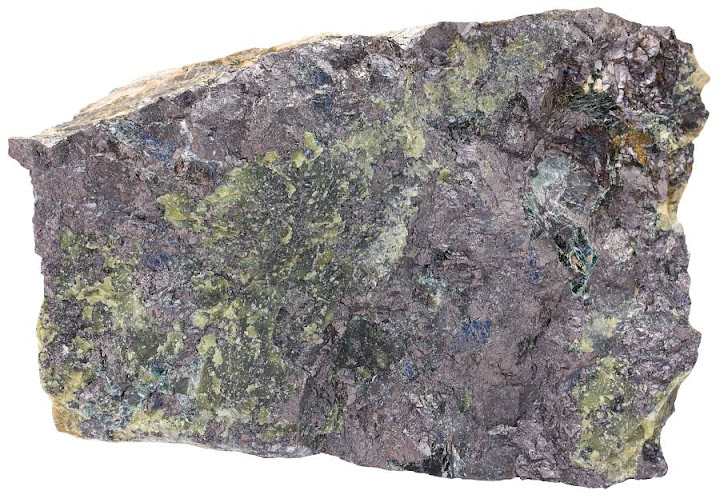
Magnetite in skarn. Gangue minerals are serpentine and talc. These minerals hint that there must be a major source of magnesium. These rocks indeed formed when magma intruded and reacted with dolomitic (Mg-Ca-carbonate) marble. Tapuli, Sweden. Width of sample 11 cm.

Skarn sample with magnetite, diopside (Ca-Mg-pyroxene), and calcite. Tapuli, Sweden. Width of sample 12 cm.
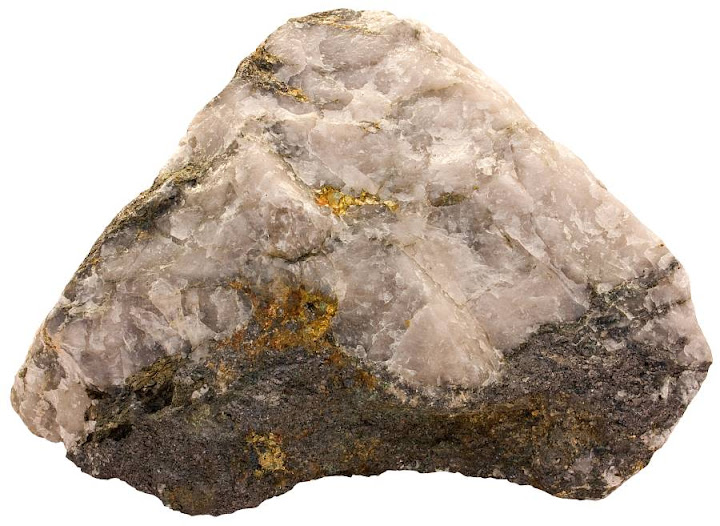
Magnetite is a common hydrothermal mineral that occurs in quartz veins with other ore minerals. This sample also contains quartz (white), pyrite, and chalcopyrite. Hannukainen, Finland. Width of sample 11 cm.
Uses
Magnetite is a major source of iron. Banded iron formations are precambrian metasedimentary rocks where the iron-bearing phase is usually either magnetite or hematite. Very rich magnetitic iron ore is in Kiruna (northern Sweden) although the formation details are not clear (it is not banded iron formation). Skarn-related iron ores are also mined although they tend to be less voluminous. Iron may be also extracted from placer deposits (heavy mineral sand).
It is industrially used as a feedstock in the manufacture of other iron-bearing materials. Magnetite has been used to make high density concrete to nuclear reactors. It is also used as a black pigment2.
Naturally magnetized magnetite is called lodestone. Normally it is only attracted to hand magnet, but magnetite itself does not attract objects mader of iron. Lodestone is different because it does that too and it readily aligns itself along the magnetic lines of the Earth. This makes lodestone useful in navigation as a natural magnetic compass. It is not entirely clear why some magnetites are naturally magnetized, but lodestones contain inclusions of maghemite (spinel group mineral) and one theory associates it with magnetic fields surrounding lightning bolts. This could explain why lodestones are found close to the surface, not from deep iron mines.
Magnetite crystals have been found in the brains of several species, including humans. It has been hypothesized that birds could make use of it to navigate, but it is not clear what benefits can they provide to humans.
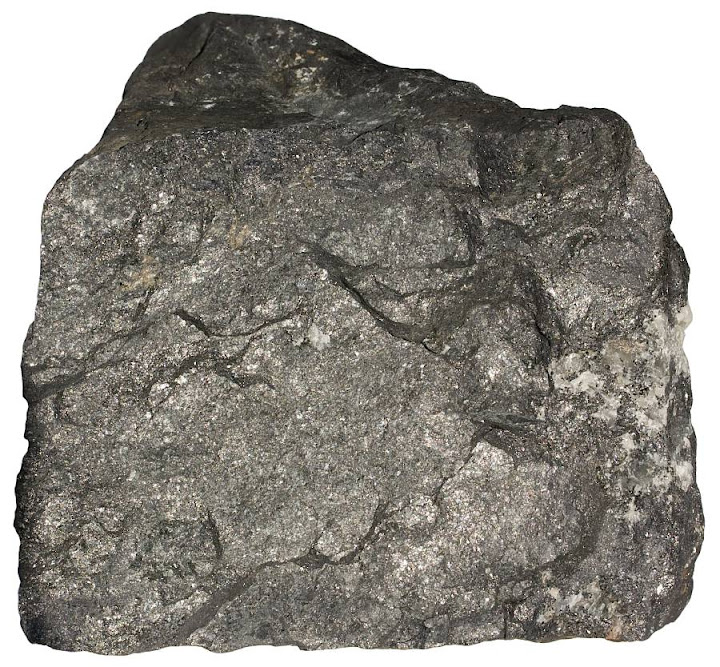
Massive chunk of iron ore which is composed of almost pure magnetite. Iron ore from Kiruna is world-famous as a very rich high-grade ore. The sample feels very heavy when compared to usual silicate rocks. Kiruna, Sweden. Width of sample 13 cm.
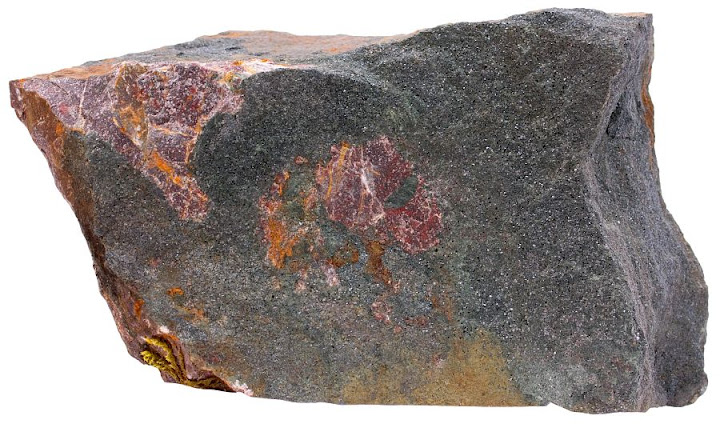
Magnetite with jasper and hematite. These minerals come from the hydrothermally altered oceanic crust. Hot newly formed oceanic crust at the mid-ocean ridge is full of cracks which allow seawater to intrude the crust. Water heats up when circulating within the rocks and leaches metals out of the basaltic crust. Metals are precipitated when this very hot and metal-rich water enters the ocean again through black smokers. These metal deposits are known as SedEx-type (sedimentary exhalative) ore deposits. Løkken ophiolite, Norway. Width of sample 13 cm.
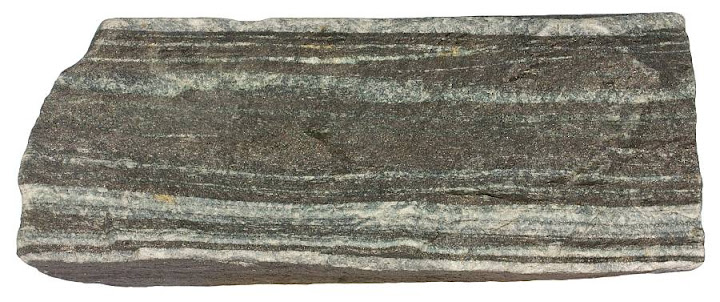
Algoma-type banded iron formation (BIF) from the Archaean. Magnetite is the principal iron-bearing ore mineral in these very old iron ores. Banded iron formation is the main source of iron although the majority of these deposits are from the Proterozoic. Bjørnevatn, Norway. Width of sample 17 cm.
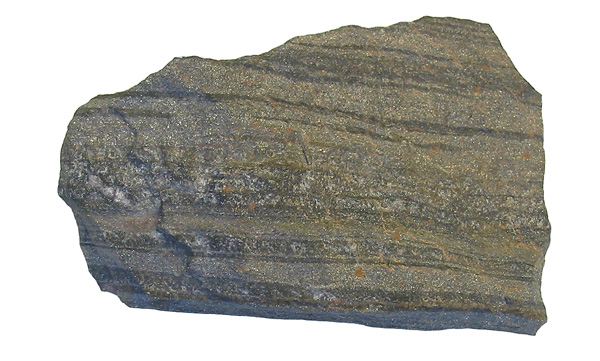
Superior-type banded iron formation from Kryvyi Rih, Ukraine. Superior-type BIFs are the main source of iron. Iron-bearing mineral in these rocks is usually either hematite or magnetite. Width of sample 10 cm.
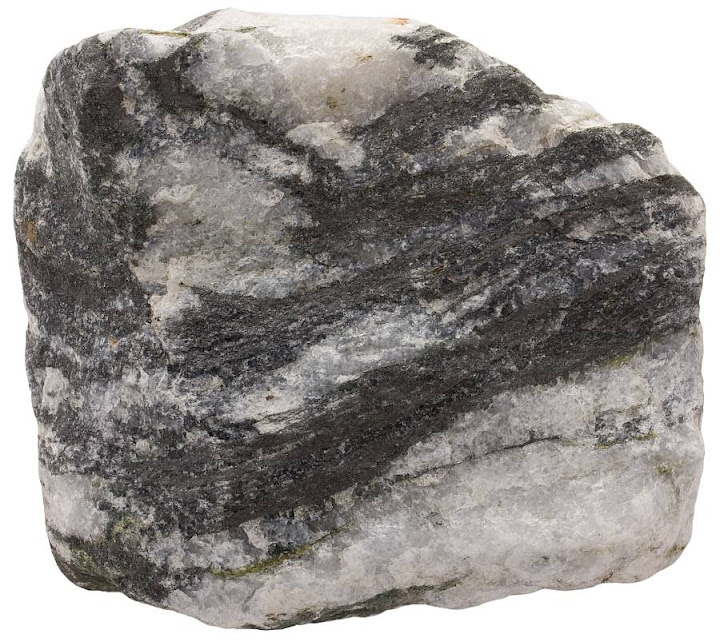
Magnetite in quartz. Bjørnevatn, Norway. The original banding of BIF is disturbed by the metamorphic processes. Width of sample 11 cm.
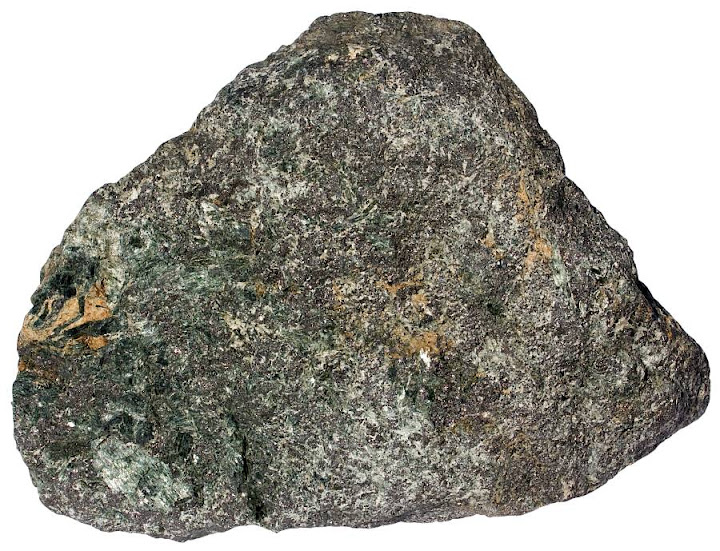
Iron ore from Kiruna. The main minerals are magnetite, calcite, actinolite, and apatite. Kiruna is the largest iron mine in Europe. Yet the formation details of these rocks are still poorly understood. Width of sample 14 cm.
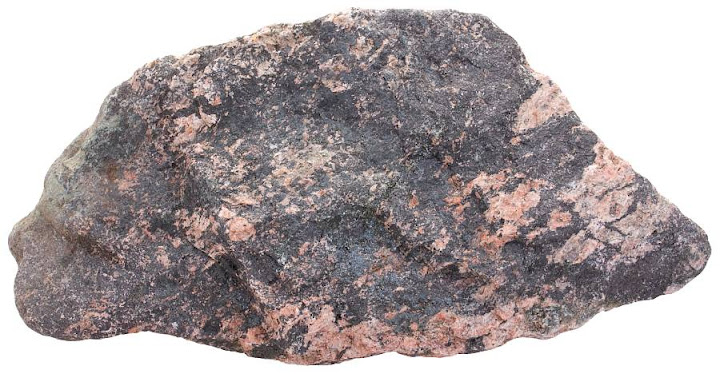
Magnetite with feldspar. Kiruna, Sweden. Width of sample 16 cm.
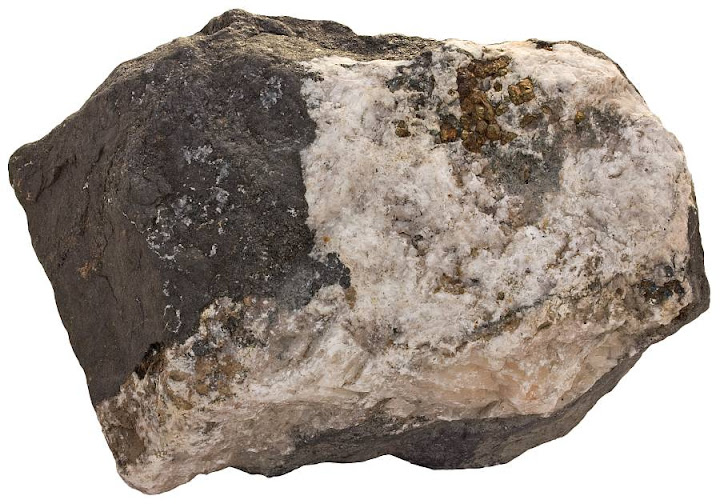
Magnetite with calcite (white) and pyrite (iron sulfide). Kiruna, Sweden. Width of sample 14 cm.
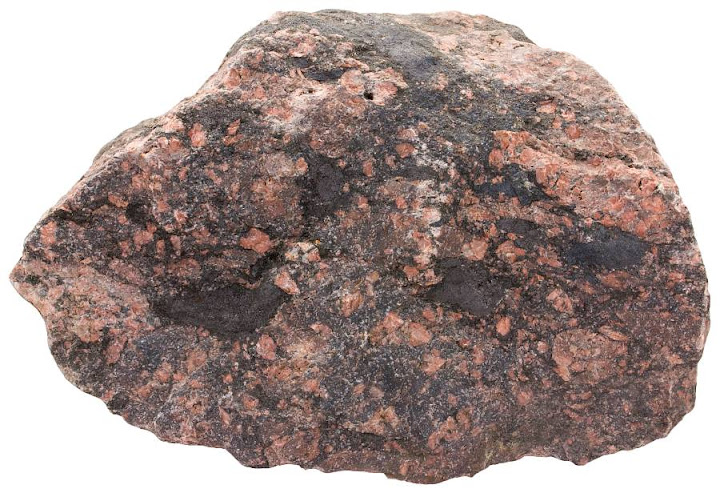
Magnetite in syenite porphyry. Kiruna, Sweden. Width of sample 15 cm.
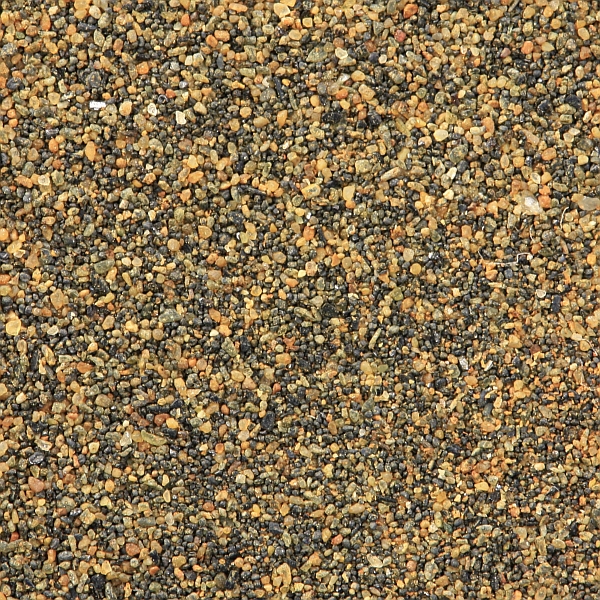
This is sand from the North Island of New Zealand. It is used as an iron ore. The black grains are titanomagnetite (total titanium content of the sample is 4 percent). Iron makes up 20 percent of the sample (XRF data). Yellow grains are silicate minerals. Width of view 10 mm.
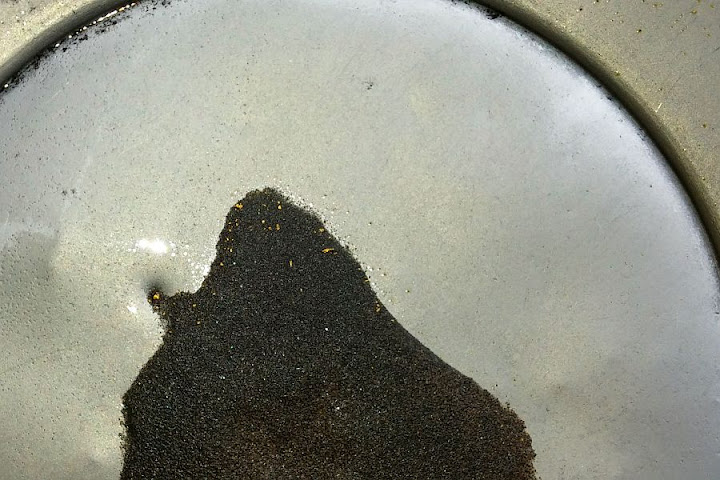
It is a major constituent in a heavy mineral fraction of sand. Lots of black minerals on this gold pan are magnetite grains. There is also gold (yellow spots). Tankavaara, Finland.
References
1. Deer, W. A., Howie, R. A. & Zussman, J. (1996). An Introduction to the Rock-Forming Minerals
2. Nesse, William D. (2011). Introduction to Mineralogy
Leave a Reply